
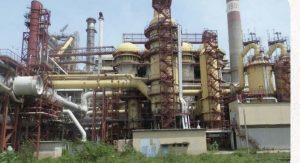
A renowned economist, Banji Oyelaran-Oyeyinka, has delivered a scathing assessment of Nigeria’s decades-long struggle with the Ajaokuta Steel Company Limited, describing the project as a “tragic failure of leadership” and a glaring “monument to unrealised potential.”
Speaking at a Virtual International Conference on Ajaokuta held on April 16, 2026, the professor lamented that despite an estimated $10 billion invested in the steel complex over more than 40 years, Nigeria has yet to produce a single tonne of steel from the facility.
“Ajaokuta suffers the sunk cost fallacy,” Oyelaran-Oyeyinka said. “As we speak, we continue pumping funds into a financial black hole, wasting precious resources.”
Located in Kogi State, the sprawling 24,000-hectare plant—designed to produce 1.3 million tonnes of steel annually—was already about 98 percent complete as far back as 1994. Yet, it has remained idle, an outcome the professor described as “an egregious symbol of our failure” and “a monumental white elephant.”
According to him, the cost of this failure extends far beyond abandoned infrastructure. Nigeria now imports roughly $4 billion worth of steel annually, a dependency he says has eroded the nation’s industrial sovereignty.
“We forfeited industrial sovereignty, relying on others for the raw material of development,” he noted. “Every tonne of steel imported builds the economies of nations that produce it.”
He estimated that if Ajaokuta had been operational, it could have supplied nearly a quarter of Nigeria’s steel needs, saving close to $1 billion annually in foreign exchange. Over four decades, he said, this translates into more than $36 billion in lost economic value—far exceeding the initial investment.
Drawing comparisons with industrial giants, the economist pointed to countries like China, India, and South Korea, which leveraged steel production as the backbone of their economic transformation.
“Steel is not just a commodity. It is the backbone of modern civilisation,” he stressed. “It builds our bridges, factories, cars and cities—it is the silent force behind industrial power.”
While these nations aligned policy, financing and leadership to build thriving steel industries, Oyelaran-Oyeyinka said Nigeria’s ambitions were derailed by corruption, policy inconsistency and poor governance.
“There is no other way to describe the story of public steel programmes in Nigeria other than a tragic failure of leadership,” he added.
Beyond the financial implications, he warned of severe human and social costs. The project was projected to directly employ over 10,000 workers and generate hundreds of thousands of indirect jobs across sectors such as mining, transport and engineering.
“Decades of lost jobs have worsened unemployment, while Nigeria missed the opportunity to build critical skills in metallurgy and industrial management,” he said, noting that Kogi State could have evolved into a major industrial hub.
To reverse the trend, Oyelaran-Oyeyinka called for the immediate privatisation of the steel complex, arguing that government control has proven ineffective.
“Decades of evidence should convince us that public officials and ministries cannot run profit-making enterprises,” he said, proposing a model where a capable Nigerian consortium partners with experienced global steel operators.
Despite the bleak history, the professor maintained that Ajaokuta still holds transformative potential. A revived steel industry, he said, could generate between $9 billion and $14 billion annually, save nearly $1 billion in foreign exchange, and create more than 70,000 jobs.
“This is not just about steel,” he concluded. “It is about sovereignty—whether Nigeria will continue to depend on others or seize control of its destiny.”
Calling the situation a national embarrassment, he added: “A country of over 230 million people without primary steel production is a travesty.”
He urged the government to act decisively—either fix Ajaokuta or enable a privately driven alternative—warning that the time for hesitation has passed.
“Let us choose progress over paralysis, action over hesitation,” he said. “Reviving Ajaokuta is not just about producing steel—it is about reclaiming Nigeria’s economic future.”
About The Author