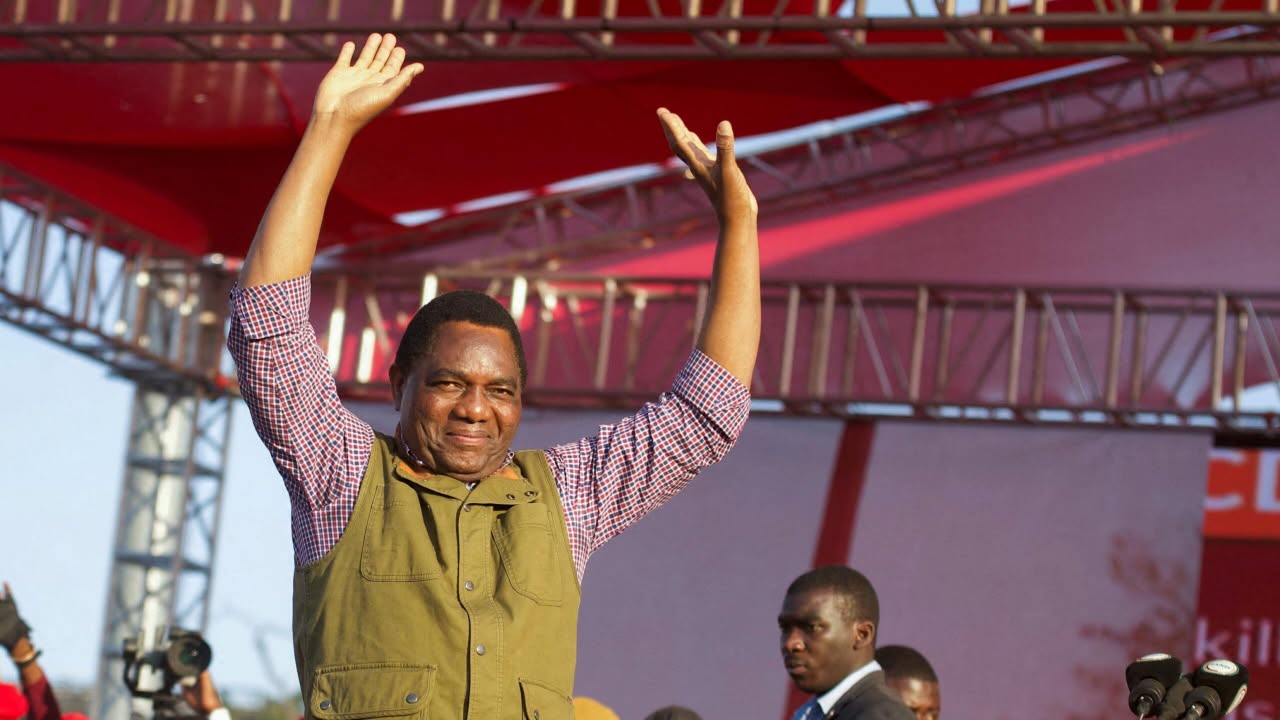
President Hakainde Hichilema has secured a second five-year term after winning Zambia’s 2026 presidential election, according to official results announced by the Electoral Commission of Zambia (ECZ). Hichilema won about 60 per cent of the vote, defeating his main challenger, Brian Mundubile, who received roughly 38 per cent.
The election was marked by a tense counting process after the ECZ temporarily suspended the tabulation of results following reports of violence at some polling stations, attacks on election officials and the theft of marked ballot papers. Counting later resumed after authorities said the security situation had been brought under control.
Hichilema’s re-election campaign was centred largely on economic recovery, stability and continuity. He took office in 2021 as Zambia struggled with the aftermath of its sovereign debt default in 2020, becoming the first African country to default during the pandemic era.
During his first term, his administration made debt restructuring, engagement with international lenders and efforts to restore investor confidence central to its economic programme. Zambia also recorded improvements in inflation and attracted increased investment, particularly in the mining sector.
Hichilema’s supporters argued that his administration had stabilised an economy that was under severe pressure when he assumed office. They pointed to Zambia’s debt restructuring and improved investor confidence as evidence that the government’s policies were beginning to produce results.
The government also promoted its record on free education, social programmes and investment, while pledging to accelerate economic growth during a second term.
However, economic recovery has not eliminated public concerns over the cost of living, poverty, electricity shortages and limited job opportunities. These issues remained important concerns during the campaign.
Mundubile mounted a significant challenge under the opposition Tonse Alliance, campaigning on concerns over living costs, governance and the distribution of Zambia’s economic resources.
However, Hichilema benefited from incumbency and a campaign message built around continued reforms. His supporters argued that changing leadership could disrupt ongoing economic programmes, while another five-year term would provide time to consolidate the progress made during his first administration.
Despite Hichilema’s victory, the election was accompanied by allegations of intimidation, violence and an uneven political environment. Opposition figures questioned aspects of the electoral process, while observers noted concerns about restrictions on political freedoms and the campaign environment.
Hichilema has called for peace and unity following the election, pledging to govern for all Zambians, including those who did not support him.
With a renewed mandate, the president now faces greater expectations to ensure that macroeconomic improvements translate into better living conditions for ordinary citizens.
His second term is expected to focus on expanding economic growth, increasing investment and developing Zambia’s copper industry, while addressing persistent challenges such as poverty, employment, energy supply and the cost of living.
About The Author