
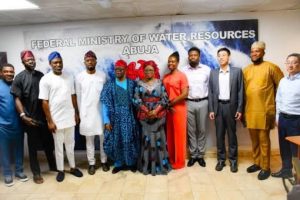
The Federal Government has signed the Concession Agreement for the Grand Katsina-Ala Hydropower Project, marking a major milestone in Nigeria’s renewable energy sector and one of the most significant public-private partnership (PPP) infrastructure deals in Africa.
As part of the agreement, the government formally appointed Maverick Energy Partners as the preferred concessionaire for the development, financing, construction and operation of a 460-megawatt storage hydropower facility on the Katsina-Ala River in Benue State.
The project, valued at approximately $1.5 billion, will be implemented under a 35-year Design, Finance, Build, Operate and Transfer (DFBOT) framework, making it one of the largest sovereign-backed renewable energy infrastructure concessions undertaken in Nigeria in recent years.
The signing follows years of planning and regulatory approvals, including concession approval by the Federal Executive Council, certification by the Infrastructure Concession Regulatory Commission and grid connection approval from the Transmission Company of Nigeria. The approvals process reflects a high level of coordination among federal institutions involved in the project.
Beyond power generation, the Grand Katsina-Ala Hydropower Project is being positioned as a catalyst for long-term economic development, with the potential to boost productivity, industrialisation and food security.
Located in Benue State, widely regarded as Nigeria’s food basket, the project is expected to improve access to reliable and affordable electricity, a key requirement for agro-processing, irrigation systems, cold-chain logistics, manufacturing and supply-chain development.
For the state, the hydropower facility represents one of the largest infrastructure investments in recent years and is expected to stimulate wider economic activity and attract further investment into the region.
Experts have long identified inadequate power supply as one of the major constraints to economic growth across Africa. By providing stable electricity, the project is expected to strengthen agricultural value chains, reduce post-harvest losses and support industrial expansion.
The development also aligns with broader continental objectives aimed at promoting regional integration, industrial growth and infrastructure expansion as African economies seek to convert natural and agricultural resources into sustainable economic output.
With an installed capacity of 460 MW and projected annual electricity generation of about 2,401 gigawatt-hours, the project is expected to deliver critical baseload power to Nigeria’s national grid while meeting rising industrial and commercial energy demand.
Hydropower remains one of the few renewable energy technologies capable of delivering reliable baseload electricity at scale, placing the Grand Katsina-Ala Project at the centre of Nigeria’s energy transition and economic development agenda.
The project is also expected to generate significant employment opportunities across engineering, construction, logistics, operations, agriculture and related sectors, creating multiplier effects for local communities and regional supply chains.
According to stakeholders, the project supports the administration of Bola Ahmed Tinubu and its Renewed Hope Agenda, particularly in the areas of infrastructure development, energy security, economic diversification and industrial growth.
Maverick Energy Partners said the project is the culmination of years of technical studies, stakeholder engagement and collaboration with government agencies.
The consortium’s leadership includes Johnson B. O. Adewumi, Babatunde Adewumi and Jean Binquet, who collectively possess decades of experience in hydropower development across Africa. Their track record includes involvement in major Nigerian projects such as the Zungeru Hydropower Project, Mambilla Hydropower Project and Gurara Hydropower Project.
The consortium noted that its principals have experience spanning engineering, procurement, construction and project development, with exposure to more than 60,000 MW of energy infrastructure projects globally.
Speaking on the significance of the project, Adewumi described Grand Katsina-Ala as more than a power generation facility.
“Grand Katsina-Ala is not simply a power project; it is a platform for economic transformation. Reliable baseload power creates the conditions for industry, manufacturing, agro-processing and long-term regional growth. We have worked for years alongside the Federal Government and our partners to build a framework that is commercially rigorous, technically strong and capable of delivering lasting impact. We believe this project can establish a new benchmark for large-scale public-private partnerships in Africa,” he said.
He further stated that the project has the potential to strengthen agriculture, stimulate regional industry, create jobs and improve economic opportunities for future generations.
“Grand Katsina-Ala represents something larger than infrastructure alone. Benue is the food basket of Nigeria, and infrastructure of this scale has the potential to strengthen agriculture, unlock regional industry, create employment and improve economic prospects for future generations. We believe this can become a model for how strategic national infrastructure is delivered across the continent,” Adewumi added.
About The Author