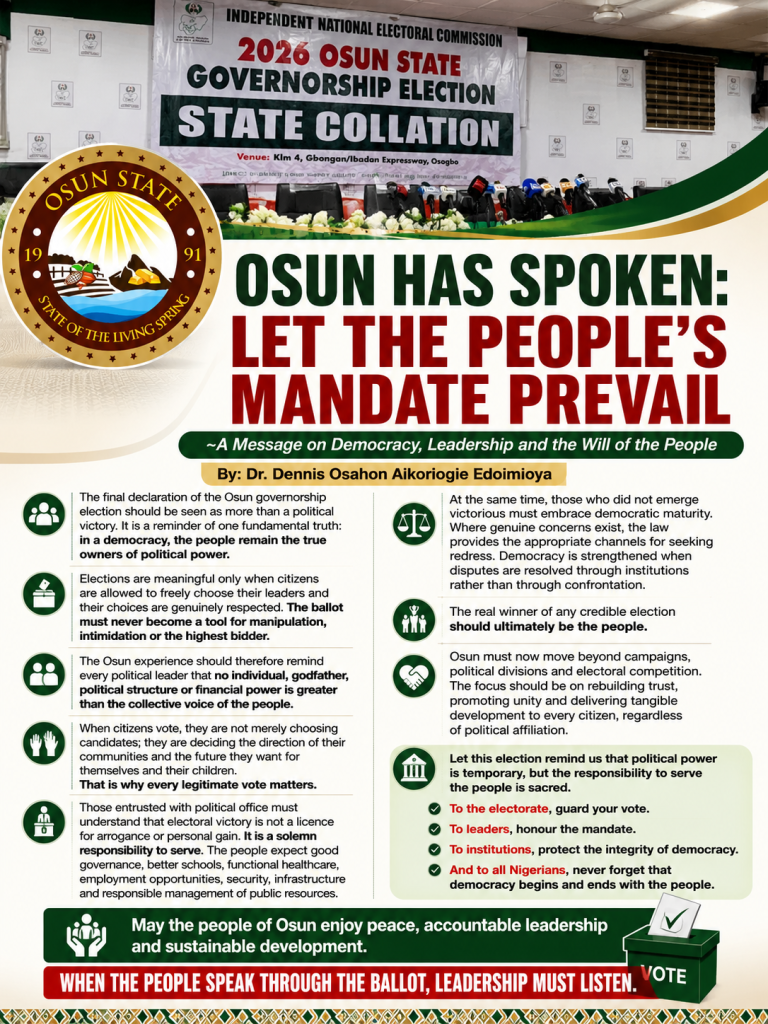

The Social Democratic Party (SDP) has described the outcome of the Osun State governorship election as a strong rejection of political intimidation and the influence of “federal might” in determining electoral outcomes.
The party said the election demonstrated that political power ultimately rests with the electorate, rather than governors, lawmakers, ministers or other influential political actors.
Speaking during a press briefing on the party’s assessment of the election, SDP National Chairman, Professor Sadiq Abubakar Gombe, said the outcome had exposed the limits of political machinery when voters are determined to protect their mandate.
Gombe said the large number of governors, National Assembly leaders, ministers, party officials and other political heavyweights who converged on Osun ahead of the election could not override the decision of the electorate.
According to him, the political establishment appeared to have assumed that deploying substantial political influence and resources would guarantee victory, but the voters demonstrated otherwise.
“They went there with everything — governors, Senate leaders, ministers and the entire political machinery — but the people of Osun stood their ground,” he said.
He added that the departure of some political figures after the results became clear should serve as a reminder that political offices do not automatically translate into control over voters.
Osun voters defied intimidation
The SDP commended the people of Osun for what it described as courage and determination in exercising their franchise despite alleged threats, intimidation and attempts to influence their choices.
Gombe said the decision of voters to remain at polling units until their votes were counted was one of the major lessons from the election.
He urged Nigerians across the country to adopt a similar approach during the 2027 general elections by voting, remaining vigilant at polling centres and ensuring that their votes are properly counted.
The party also highlighted the reported increase in voter turnout, which it put at about 49 per cent, compared with roughly 30 per cent during the 2023 governorship election.
The SDP said the increase was significant, particularly against the backdrop of what it described as an atmosphere of intimidation and aggressive political mobilisation.
‘APC is not unbeatable’
The party said the Osun election had also challenged the perception that the ruling All Progressives Congress (APC) could not be defeated at the polls.
“It is a warning signal to the ruling party to know that they are not sacrosanct. They can be defeated,” Gombe said.
He argued that access to government institutions and political structures should not be mistaken for permanent control of the electorate.
According to him, political parties may have access to significant resources and organisational structures, but such advantages cannot guarantee permanent voter loyalty.
The SDP also noted that the election exposed divisions among opposition parties that have been discussing possible alliances ahead of 2027.
It observed that despite the absence of a unified opposition platform in Osun, voters appeared to have rallied around the candidate they believed could challenge the ruling party.
“The opposition leadership did not come together, but the people of Osun came together,” Gombe said.
He suggested that if opposition leaders fail to resolve their differences, Nigerian voters could eventually create their own political coalition through the ballot.
SDP praises INEC
The SDP also commended the Independent National Electoral Commission (INEC) for the conduct of the election, saying the commission had enhanced public confidence by allowing the voters’ decision to prevail.
Gombe urged INEC Chairman, Professor George Akpabio, and the commission to sustain what the party considered a positive standard ahead of the 2027 elections.
He said Nigerians should be willing to commend electoral institutions when they conduct credible elections instead of condemning them indiscriminately.
“If INEC does the right thing, Nigerians need to come out in unison and applaud and encourage INEC,” he said.
Party raises concerns over security deployment
Despite its commendation of the electoral process, the SDP expressed concern over the scale of security and personnel deployment required for the Osun election.
Gombe questioned whether Nigeria had enough security and electoral personnel to replicate a similar level of deployment across the country’s 774 local government areas during the 2027 elections.
He called on INEC and security agencies to begin preparations early, stressing that manpower, logistics and security challenges must be addressed well ahead of the general elections.
The SDP chairman also criticised governors and other senior public officials who allegedly left their states to participate actively in the Osun election.
He urged security agencies, particularly the police, to ensure compliance with electoral regulations governing the activities and movement of political office holders during elections.
According to him, the deployment of state resources and the presence of numerous political office holders in another state could create an uneven electoral environment.
‘Osun has sent a message to Nigeria’
The SDP said the most significant feature of the Osun election was not the presence of powerful political figures but the determination of ordinary voters to defend their votes.
The party maintained that democracy is ultimately determined by voters and not by the number of governors, senators, ministers or political operatives deployed to an election.
Gombe urged Nigerians in states facing insecurity, poverty and poor governance to draw lessons from Osun and use their votes to demand accountability.
He specifically referenced states such as Zamfara, Katsina, Borno and Sokoto, saying their residents could similarly use elections to express their demands for better governance.
“If the people of Osun can come out and defend their mandate, then Nigerians in other parts of the country can do much more,” he said.
The SDP said the Osun election had therefore gone beyond being a state-level political contest, describing it as a national lesson on the power of the electorate.
According to the party, the central message from Osun is that political influence, government positions and financial resources may shape an election, but a determined electorate can still make the ballot more powerful than political machinery.
About The Author