By Comrade Peter Nwokolo
Citizens Rights and Leadership Awareness Initiative
Local Government administration in Nigeria has always been a very contentious issue and over the past few years, the major problem has been the premium and priority placed on this 3rd tier of Government in our political equation. While activities at the federal and States are given prominence, local Governments are quite often seen as a less important tier of Government, so much so, that its role as the primary tool which is supposed to engender development at the local levels has been systemically eroded in the last few years.
While the Nigerian constitution envisaged a federal system of Government, where the 36 States that make up the Nigerian federation are given autonomous powers to administer their respective States, the same constitution ironically, has not placed commensurate fiscal resources at the disposal of the local Governments to enable them discharge their statutory responsibilities as envisaged by the constitution of the federal republic. It is such constitutional anomalies and landmines that have rendered local Government administration in the country ineffective and thereby depriving the people at the grassroots the required political and economic advantages that comes from a well balanced political structure predicated on constitutional democracy as practiced in other climes.
Local Governments as the 3rd tier of Government is perhaps one of the most important in our democracy and the peace, progress and development of our nation is inextricably tied to the success and well articulated framework of this tier of Government as envisioned by the constitution, because of its close affinity to the rural dwellers.
Nigeria as a federal State must now begin to genuinely devolve powers to its constituent units and allow the resources of the States to trickle down to the local people who are indeed, the last bastion of our democracy.
With 774 local Governments across the federation and with some States creating additional local council development areas, it has become imperative to immediately embark on a genuine, functional and accountable constitutional amendment exercise, that will tackle the lingering question of the principles of derivation which has since become a festering sore between the Federal Government, the States and the local Governments.
With Nigeria operating almost a Mono-Economic structure, based significantly on petroleum and with States and local Governments all running to Abuja, the Federal capital for their own share of what is referred to here as the “National Cake” the constitution amendment has become a matter of urgent national attention, so that local Governments in Nigeria can take their rightful place in addressing the many thorny issues begging for solutions at the local Government levels and ensuring that the rural communities can begin to feel the real impact of the much taunted democracy dividends.
Due to the disparities in the local Government system in Nigeria, there is now what is referred to here as “Abuja politicians” Abuja politicians refers essentially to politicians who reside in Abuja, Nigeria’s Federal capital and in most cases, with no grass roots political appeal but some of whom are perceived as a powerful political block, because of their close proximity to the seat of Federal power. These class of politicians are always at logger-heads with their counterparts at home over control of the party machinery in their respective States and local Governments and more often, such inter and intra-party rivalry has impacted negatively on the smooth running of affairs in the States and quite naturally, the local Governments across the political spectrum in the country.
Such politics of imposition and power play was more prevalent during the administration of the former President, Olusegun Obasanjo between 1999 and 2007 where high wire politics between the politicians in Abuja and those in other States took a more frightening dimension, resulting to the denial of constitutionally mandatory federal allocations to some States, because one particular State had gone ahead to create additional area council development authorities against the wish of the Federal Government, even when the country’s highest court, the Supreme court had ruled that the denial of funds to that State was grossly unconstitutional.
President Obasanjo, was himself, then perceived as a typical Abuja politician because of his lack of grass-roots political appeal but who had deployed the powers of the Federal Government at his disposal to muscle both political opponents and friends alike. It is therefore absolutely important that the issue of how to share the funds accrued from the national economy between the three tiers of Government is immediately resolved, to enable the local Governments deliver o’s its constitutionally assigned responsibility to the rural people, to help stem the rising influx of rural dwellers into the city center.
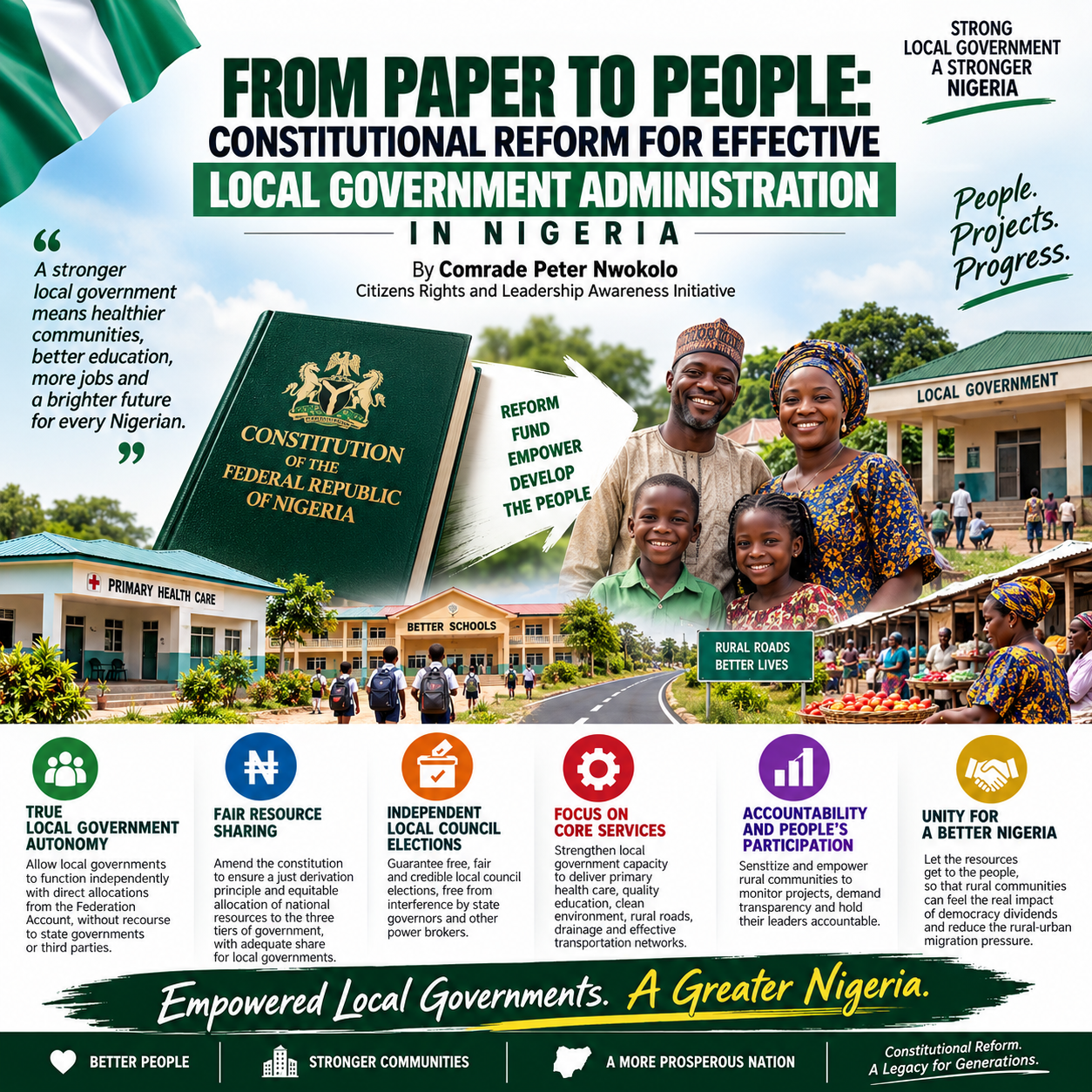
Local Governments must be given the resources due to it and directly too from the federation account without recourse to the States or any other 3rd parties. Local Government administration can only deliver on its responsibilities if the desired resources are made available directly to the end users and at the right time, without undue political influence from the States or the Federal Government. The provision of primary health care, good drainage system, re-activation and reconstruction of primary and secondary schools within the jurisdiction of the various local Government must be given prominence to enable them perform optimally. Tax collection within local Governments and effective transportation network and rehabilitation of rural roads must be given priority by the local Governments.
There must be a conscious and deliberate sensitization of the rural people to ensure that they are made aware of their responsibilities on the effective running and monitoring of affairs of their leaders at the local level. Local Governments everywhere are a very vital chain in the development of any nation. Nigeria as a Federal State must do more to improve the local Government administration in the country.
Local government autonomy such as we have now, can no longer suffice. Local governments must truly be allowed to function effectively and this can only happen when there are independent local council elections, devoid of any form of interference from the Governors across the Federation.
This is a patriotic call to national peace, progress and advancement of democracy and the rule of law.
About The Author