

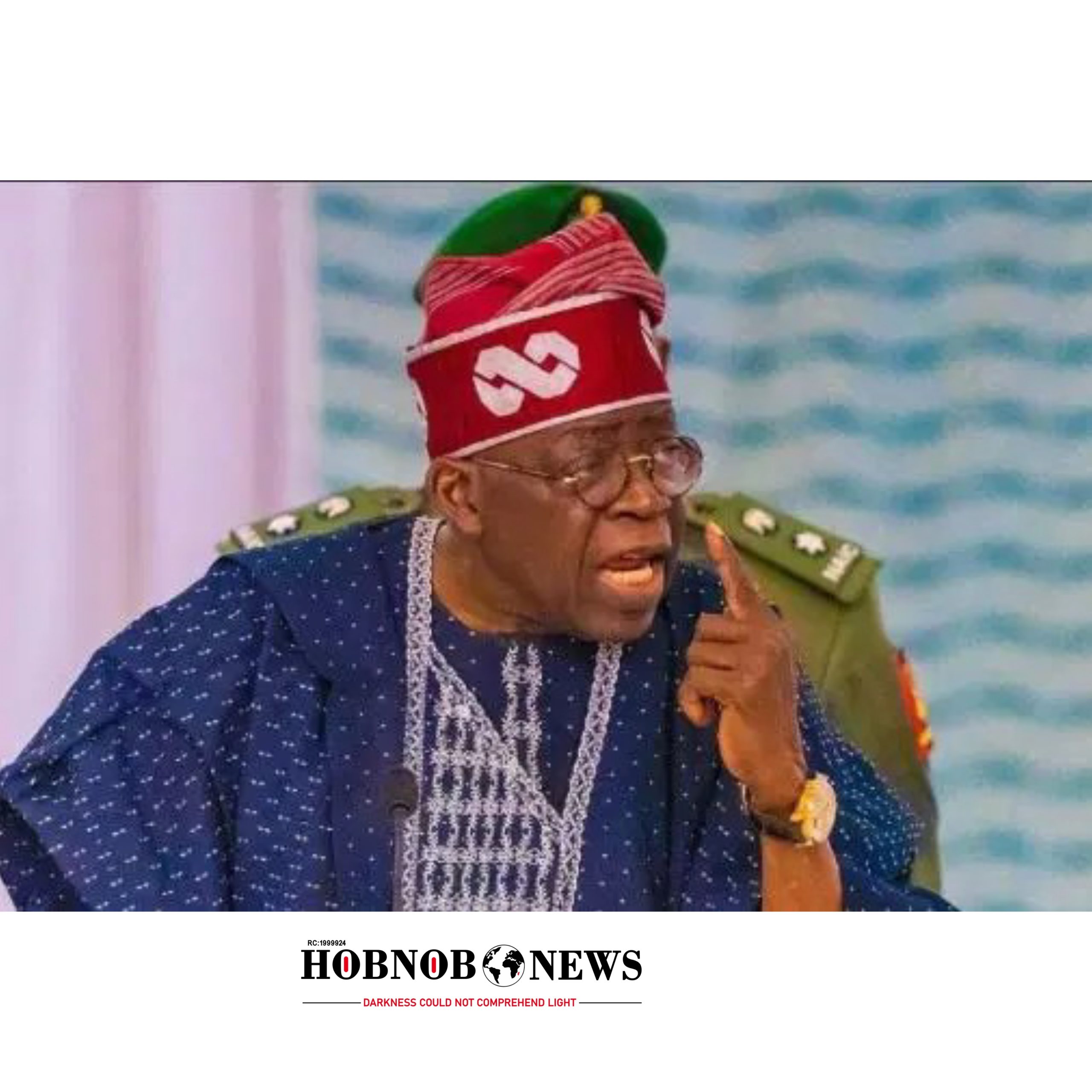
President Bola Tinubu on Wednesday sternly reaffirmed his standing order to immediately withdraw Nigeria Police Force personnel attached to Very Important Persons (VIPs) and redeploy them to core policing duties, expressing frustration over the slow pace of compliance.
Minutes before presiding over the Federal Executive Council (FEC) meeting at the State House, Abuja, the President emphasized that the directive must be immediately effected to combat the ongoing security crisis.
Immediate Police Replacement and Arming Forest Guards
Sounding resolute, President Tinubu directly instructed the Minister of Interior, Dr. Olubunmi Tunji-Ojo, to liaise with the Inspector-General of Police (IGP), Kayode Egbetokun, and the Nigeria Security and Civil Defence Corps (NSCDC) to ensure swift replacement of the withdrawn escorts.
“I honestly believe in what I said…It should be effected. If you have any problem because of the nature of your assignment, contact the IGP and get my clearance,” Tinubu said. “The minister of interior should liaise IG and the Civil Defence structure to replace those police officers who are on special security duties. So that you don’t leave people exposed.”
He further tasked the National Security Adviser (NSA), Nuhu Ribadu, and the Department of State Services (DSS) to issue additional guidance and form a committee to review the deployment structure, instructing the NSA to take the arming of forest guards very seriously.
“I know some of our people are exposed and I understand that we have to make exceptional provision for them and civil defence is equally armed and I want to know that from NSA to arm our forest guards too, take it very seriously,” the President stressed.
Framing the move as a crucial response to the spike in abductions, the President stated, “We are facing challenges of kidnapping. We need all the forces we have on the ground, fully utilised.”
The renewed charge comes nearly three weeks after the initial November 23 directive, which followed a security meeting held after a series of attacks involving the kidnapping of at least 300 people, primarily schoolchildren, across Kebbi, Kwara, and Niger States. The earlier directive mandated that VIPs seeking police protection should now request well-armed personnel from the NSCDC.
Presidential Son’s Security Detail Sparks Controversy
The President’s renewed insistence on compliance follows recent public comments from Nobel Laureate, Professor Wole Soyinka, regarding the security details attached to the President’s son, Seyi Tinubu.
Speaking at the 20th Wole Soyinka Centre for Investigative Journalism Awards in Lagos on Tuesday, Professor Soyinka described seeing “an excessively large security battalion assigned to a young individual close to the Presidency,” an entourage he said was “sufficient to take over a small country.”
In a viral video, Soyinka recounted contacting the NSA to track down the deployment: “I said do you mean that a child of the head of state goes around with an army for his protection or whatever. I couldn’t believe it. Later on, I did some investigative journalism, and I found that apparently this is how this young man goes around with his battalion, his heavily armed soldiers.”
Shettima to Lead Ranching Initiative
Separately, President Tinubu tasked Vice-President Kashim Shettima to spearhead a major national ranching initiative aimed at defusing farmer-herder conflicts and formalizing the livestock economy.
The President directed the Vice President to use the National Economic Council (NEC) to identify and rehabilitate grazing reserves into modern ranches and livestock settlements.
“Again, especially livestock reform, I think the Vice President should get the NEC first of all to see which villages or grazing reserves can be salvaged or rehabilitated into Ranches, Livestock settlements,” Tinubu directed. “We must eliminate the possibility of conflicts and turn the Livestock reform into economically viable development. The opportunity is there. Let’s utilise it.”
He emphasized that since the land constitutionally belongs to the states, the NEC must exercise that requirement to salvage and convert grazing areas into economically viable livestock villages to stop conflicts and foster prosperity.

