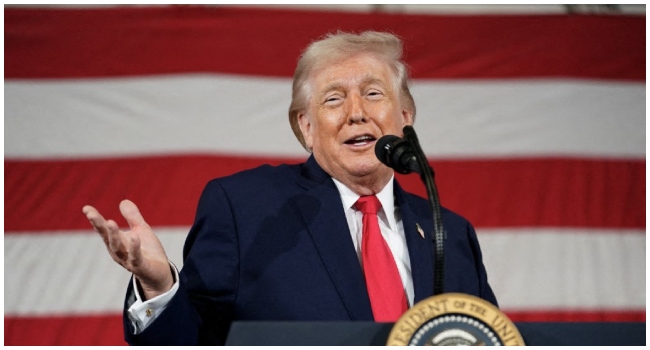
President Donald Trump has increased the United States’ global import tariff to 15 percent, just a day after the Supreme Court of the United States struck down much of his sweeping tariff program.
Announcing the decision on his Truth Social platform, Trump said the administration would impose the “fully allowed, and legally tested” 15 percent rate following what he described as an “extraordinarily anti-American decision” by the court.
The move comes after the Supreme Court ruled 6–3 that the president lacked authority under a 1977 economic emergency powers law to enforce broad tariffs. In response, Trump initially introduced a 10 percent global levy through a different legal pathway before raising it further to 15 percent.
The new tariff, which is temporary and permitted for up to 150 days, exempts sectors under separate investigations, including pharmaceuticals, as well as goods traded under the US-Mexico-Canada Agreement.
The ruling marked one of the most significant judicial setbacks for Trump since returning to office 13 months ago. While the court has generally expanded presidential authority in recent decisions, it rejected this use of emergency powers to underpin a key pillar of Trump’s economic agenda.
Trump sharply criticised the six-justice majority — including two of his own nominees — accusing them of being influenced by “foreign interests.” However, he praised conservative justices Clarence Thomas, Samuel Alito, and Brett Kavanaugh for supporting his position.
The court’s decision does not affect separate tariffs on steel, aluminium, and other goods, which were imposed under different legal authorities. Additional sector-specific tariffs could still emerge from ongoing government investigations.
Despite the legal setback, Wall Street responded calmly, with shares rising modestly after the anticipated ruling. Business groups welcomed the judgment, saying it offers greater certainty for companies navigating fluctuating trade policies.
Trump acknowledged that prolonged legal battles could follow, particularly over whether companies should receive refunds for tariffs collected if deemed unlawful — a process Justice Kavanaugh warned could become complicated.
The latest tariff hike is expected to heighten uncertainty in global trade, as Trump presses ahead with his combative approach to international commerce.
About The Author