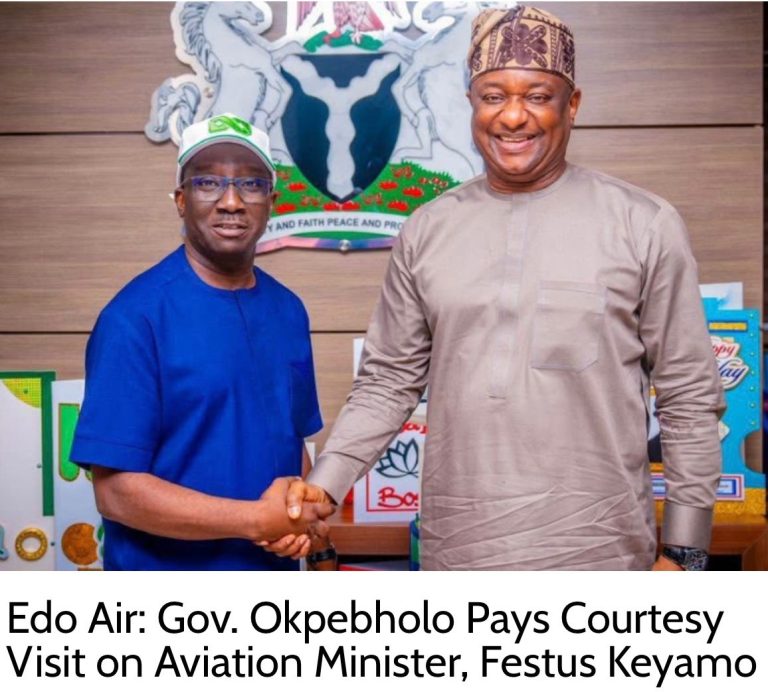
First, I acknowledge the fact that floating an airline is capital intensive. I also acknowledge the fact that most state governments in Nigeria are setting up their own state airlines. Development, however, has never been about avoiding capital-intensive ventures; it has always been about making strategic investments that deliver direct impact, long-term value, and broad-based benefits to the people.
We do not discard a venture simply because it requires capital. The real questions are: Does it benefit the people? Does Edo State have a market for it? Does it align with emerging national and global economic realities? On all these questions, the answer is clearly in the affirmative.
Edo State has a strong and proven market for air travel. Edo people are among the most travelled populace in Nigeria driven by commerce, education, healthcare, tourism, cultural exchanges, and a vast diaspora network. Passenger traffic between Benin City and major Nigerian cities already demonstrates consistent demand. A state-backed airline, properly structured and commercially driven, is therefore not speculative but responsive to an existing and growing need.
Nigeria, through the Nigerian Civil Aviation Authority (NCAA), has entered into a strategic partnership with Airbus to establish local Maintenance, Repair and Overhaul (MRO) facilities. This initiative is aimed at reducing dependence on foreign aircraft maintenance, lowering operational costs for airlines, supporting new national and sub-national carriers, and positioning Nigeria as a West African aviation hub.
This national policy direction fundamentally changes the economics of aviation in Nigeria. With local MRO facilities, the historical argument of prohibitive maintenance costs often cited to oppose state airlines loses much of its weight. Edo State, by aligning with this evolving aviation ecosystem, stands to benefit from reduced costs, skilled job creation, technical capacity building, and integration into a regional value chain.
The PDP’s attempt to label the airline initiative as “cretinous governance” is therefore not only intemperate but deeply uninformed. Aviation is not a vanity project; it is a strategic economic enabler. It strengthens tourism, supports hospitality and culture-based investments, attracts conferences and investors, enhances ease of doing business, and creates direct and indirect employment opportunities.
While concerns about infrastructure, roads, drainage, healthcare, and education are valid and must be addressed, it is intellectually dishonest to suggest that Edo State must choose between fixing the basics and investing in future-facing economic sectors. Governance is not a single-lane road. Progressive administrations fix inherited deficits while simultaneously laying the foundation for sustainable growth.
It is also misleading to assume that a state airline must follow the outdated model of fully government-owned, poorly managed enterprises. Modern aviation ventures emphasise public-private partnerships, professional management, phased investment, route optimisation, and strict commercial discipline. With the right structure, transparency, and oversight, fiscal exposure is minimised while economic returns are maximised.
Edo State does not need politics of fear or the language of insults. It needs honest, data-driven conversations about how to unlock its full potential. Shrinking ambition has never built a prosperous state; strategic planning and bold but responsible thinking have.
Edo State does not lack challenges but it must not lack vision. A state airline, aligned with national aviation reforms and supported by an existing travel market, represents an opportunity for growth, connectivity, and economic diversification. It deserves sober evaluation, not political ridicule.
Dr. Dennis Osahon Aikoriogie
*Economist & 2024 Edo Governorship Candidate*