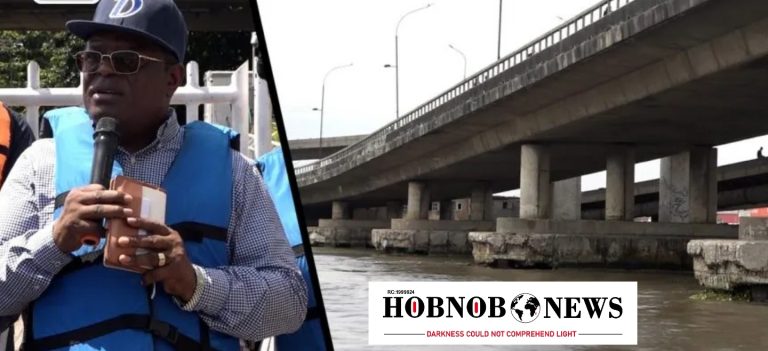
Minister of Works David Umahi has disclosed that structural rehabilitation of Lagos State’s Third Mainland Bridge will cost about ₦3.8 trillion, warning that severe underwater damage threatens the country’s busiest bridge.
Speaking after Wednesday’s Federal Executive Council meeting in Abuja, Umahi said inspections revealed extensive deterioration of the bridge’s piles and piers, caused mainly by illegal sand mining, erosion, and corrosion. He noted that building a new bridge could cost slightly less, at about ₦3.6 trillion.
According to Umahi, seven specialist contractors have been approved to conduct detailed investigations, designs, and bids for both rehabilitation and new construction under an EPC+F (Engineering, Procurement, Construction, and Financing) model. Similar assessments on the Carter Bridge, he added, prompted contractor Julius Berger to recommend full replacement at an estimated ₦359 billion.
The government will advertise PPP bids for the projects and engage international lenders such as Deutsche Bank. Umahi stressed that decades of neglect and human activities have undermined the bridge’s foundation, making urgent action essential.
FEC also approved emergency repairs on other damaged bridges, including the Jalingo Bridge in Taraba State, Ido Bridge, Keffi Flyover in Nasarawa, Mokwa Bridge in Niger, a bridge on the Abuja–Kogi route, several on the Lagos–Ibadan corridor, the Jebba Bridge in Kwara, and the Itokin–Ikorodu Bridge in Lagos. These will be submitted to the President for approval through the Ministry of Finance.
Commissioned in 1990, the Third Mainland Bridge is Nigeria’s longest and a vital link for Lagos’ estimated 20 million residents. While it has undergone periodic maintenance, Umahi said recent inspections uncovered damage far worse than previously recorded.