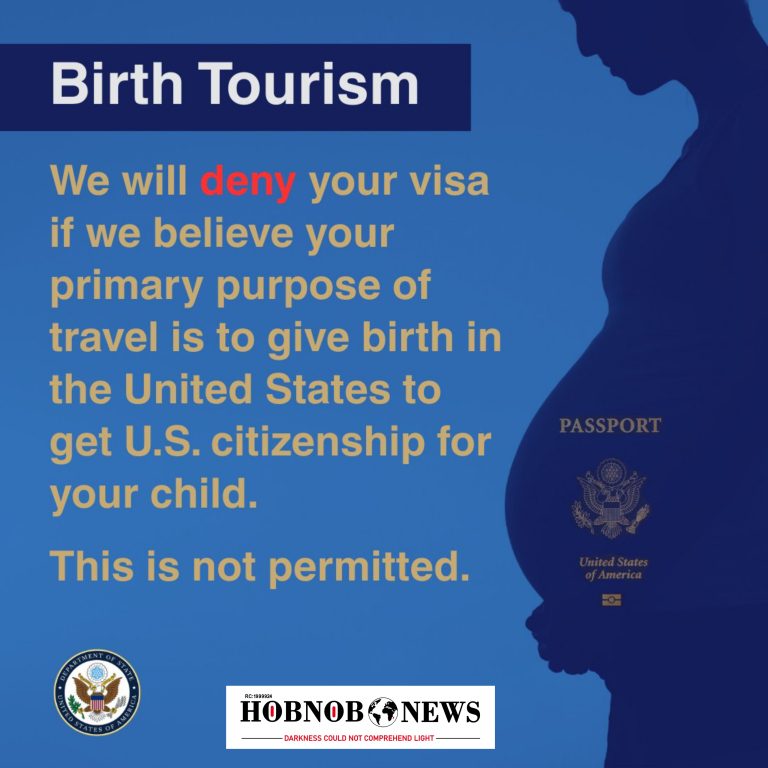
The United States Mission in Nigeria has issued a strong warning to Nigerian citizens against using visitor visas for the primary purpose of giving birth in the U.S. to secure automatic citizenship for their children.
In a post shared on its official X (formerly Twitter) account, the mission emphasised that such acts—commonly referred to as “birth tourism”—are not permitted under U.S. immigration policy. The post stated:
> “Using your visa to travel for the primary purpose of giving birth in the United States so that your child will have U.S. citizenship is not permitted. Consular officers will deny your visa application if they have reason to believe this is your intent.”
The statement was accompanied by the hashtag #VisaWiseTravelSmart.
This warning aligns with existing U.S. policy dating back to January 2020, when the Department of State formally announced that childbirth for the sole purpose of obtaining citizenship would no longer be considered a valid reason to issue B‑1/B‑2 tourist visas. The rule was introduced under the Trump administration and has remained in force, with enforcement mechanisms becoming more stringent in recent months.
Consular officers are now required to deny visa applications if they suspect the applicant intends to travel to the U.S. primarily to give birth. Visa applicants found to be dishonest about their purpose of travel may also face revocation of existing visas or long-term bans from entering the country.
The U.S. government has prosecuted facilitators of birth tourism in the past, with one high-profile case in 2025 resulting in a 41-month prison sentence for a California-based woman who arranged for foreign nationals to give birth in U.S. hospitals.
While childbirth for legitimate medical reasons remains legal under U.S. immigration law, applicants must provide strong evidence of medical necessity, financial preparedness, and intent to return to their home country after treatment. Any lack of transparency or perceived abuse of the visa process may lead to automatic disqualification.
The U.S. Mission’s advisory serves as a fresh reminder to Nigerian applicants to be fully honest about their travel intentions and to avoid practices that may be deemed fraudulent under U.S. law.