
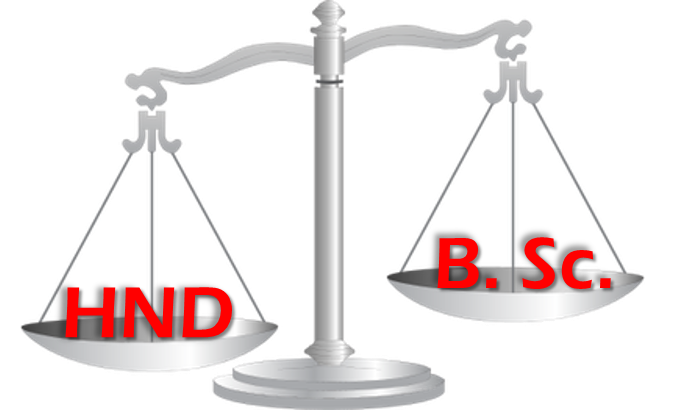
The call to eliminate the lingering disparity between Higher National Diploma (HND) and Bachelor’s Degree qualifications has gained renewed momentum as education stakeholders urge the Federal Government to take decisive steps in creating parity between both credentials.
In a series of interviews with Hobnob News, key figures in Nigeria’s polytechnic education system emphasized that removing the HND-Degree divide would foster a more inclusive, equitable, and skills-driven education ecosystem.
Dr. Ibraheem Abdul, Rector of Yaba College of Technology (YABATECH), stressed the importance of implementing existing federal policies aimed at bridging the divide. “The government must reflect parity in recruitment, promotions, and career progression,” he said. “There’s also a need to convert select, well-established polytechnics into degree-awarding institutions or universities of technology with a focus on hands-on practical training.”
Dr. Abdul added that while the Post Graduate Diploma (PGD) serves as a transitional pathway for many HND holders, it has not fully addressed the gap in the job market. “In several cases, HND graduates are still disadvantaged despite obtaining PGDs. Conversion programmes, coupled with professional certifications, could bring better alignment with first-degree holders,” he noted.
Mr. Ojo Monday, Chairman of the Academic Staff Union of Polytechnics (ASUP), YABATECH Chapter, described the continued dichotomy as a major setback to the growth and perception of polytechnic education in Nigeria.
“In truth, PGD is not closing the HND-Degree gap the way it should,” Monday said. “One solution could be the transformation of polytechnics into polytechnic universities—as seen in countries like the United Kingdom—where vocational and technical education are given equal prominence.”
Sharing her personal experience, Silvia, an HND graduate, said many like her often feel marginalized in the job market. “We are made to feel less qualified, despite our skills and training. Eliminating the disparity will validate our efforts and encourage more youth to pursue polytechnic education confidently,” she said.
The issue of HND-Degree discrimination has long been a source of national debate. In a significant move toward reform, both chambers of the National Assembly passed a harmonized bill in 2021 to prohibit discrimination between the two qualifications.
Titled: “Bill for an Act to Abolish and Prohibit Dichotomy and Discrimination between First Degree and Higher National Diploma in the Same Profession/Field for the Purpose of Employment and for Related Matters,” the legislation prescribes equal treatment in employment and career advancement.
However, despite its approval in both the Senate and the House of Representatives, the bill remains unsigned and unenforced. As a result, HND holders in Nigeria’s civil service remain unable to progress beyond Grade Level 14—regardless of their competence or years of service.
Stakeholders are now urging the executive arm of government to act swiftly. “This is not just about fairness. It’s about harnessing the full potential of Nigeria’s technical and vocational education sector,” said Monday.
As the conversation around skills, innovation, and inclusive education grows louder, advocates believe that the abolition of the HND-BSc divide is long overdue—and vital to national development.
About The Author