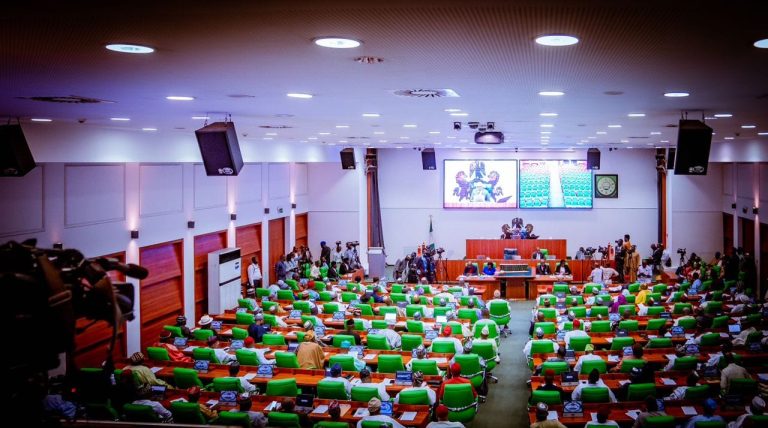
The House of Representatives has voted down a contentious constitutional amendment bill proposing mandatory rotation of the offices of President and Vice President among Nigeria’s six geopolitical zones.
The proposal, part of a broader constitutional review, was among seven amendment bills tabled during Tuesday’s plenary session, presided over by Deputy Speaker Benjamin Kalu. All seven bills were ultimately rejected, though the House resolved to revisit each proposal individually during Wednesday’s session.
To streamline the process, House members had earlier suspended their rules, allowing for simultaneous debate on all seven amendments. The rotational presidency bill quickly became the most debated, dividing lawmakers along ideological lines.
Arguments Against Rotation
Deputy Minority Leader Aliyu Madaki led the opposition, asserting that the Federal Character principle already ensures equitable representation and that such rotation should be left to party mechanisms.
“The Constitution should not dictate rotation. Political parties already have internal structures to guarantee fairness,” Madaki stated.
Echoing this view, Sada Soli (APC, Katsina) warned the bill could dilute leadership quality and stoke ethnic tensions.
“Imposing a rotational system will not serve Nigeria’s long-term interests,” he said. “It risks fueling division rather than unity.”
Bello El-Rufai (APC, Kaduna) raised constitutional and practical concerns, referencing the 2010 death of President Yar’Adua.
“Would the Vice President be asked to step down in such cases just to maintain zoning?” he questioned, adding that a rotation clause could infringe on citizens’ rights to freely contest public office.
Olumide Osoba (APC, Ogun) warned that the amendment would undermine party autonomy.
“It’s not the role of the Constitution to dictate how political parties select candidates,” he noted.
Arguments in Support
Despite the opposition, several lawmakers voiced support for the proposal. Shina Oyedeji (PDP, Oyo) said rotational leadership would promote a sense of inclusion across ethnic lines, though he acknowledged its complexities.
“Zoning could raise issues of intra-regional fairness too. For instance, if it’s zoned to the South-West, which state takes precedence?” he asked.
Minority Whip Ali Isa supported the bill wholeheartedly, urging that the rotation principle be extended to governorship positions within states.
“There is no shortage of capable leaders across the regions,” Isa said. “Every geopolitical zone deserves a shot at the presidency.”
Clement Jimbo (APC, Akwa Ibom) added that the bill sought to correct historical inequalities and recommended a sunset clause to phase out the principle after each zone has produced a president.
Other Rejected Bills
Beyond the rotational presidency proposal, the House also shot down:
A bill to transfer political party registration from INEC to a new Registrar-General of Political Parties.
A proposal to raise the number of Federal High Court judges to 100 or more.
An amendment to expand Federal High Court jurisdiction to include maritime and inland waterway matters.
A bill to grant autonomy to the Offices of State Auditors-General for Local Governments and FCT Area Councils.
A proposal to create Ughelli East Local Government Area in Delta State.
A bill to authorize the National Judicial Council and National Salaries, Incomes and Wages Commission to review judiciary remuneration.
Each bill was debated, but none secured the support needed for passage.
Hobnob News will continue to monitor the House’s proceedings as lawmakers reconvene to evaluate these proposals one by one.