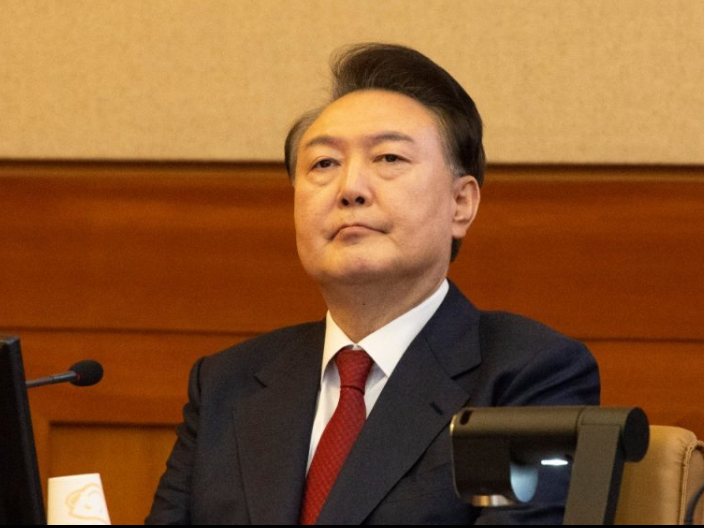
In a seismic political development, South Korea’s Constitutional Court on Friday unanimously ruled to remove President Yoon Suk Yeol from office, following his impeachment over a failed attempt to subvert civilian rule through a shocking martial law declaration last December.
The decision, watched live by millions across the country, marks the second time in South Korea’s history that a sitting president has been removed by the court. Yoon, 64, was arrested immediately after the ruling on separate insurrection charges related to his deployment of armed troops to the National Assembly on December 3, 2024.
“Given the serious negative impact and far-reaching consequences of the respondent’s constitutional violations… (We) dismiss respondent President Yoon Suk Yeol,” said acting Chief Justice Moon Hyung-bae in a televised address, citing Yoon’s breach of the constitutional order and abuse of military power for political ends.
The court found that Yoon’s attempt to use military force to stop lawmakers from voting down his emergency decree “violated the political neutrality of the armed forces” and amounted to a betrayal of democratic governance. “The respondent’s unconstitutional and illegal acts are a betrayal of the people’s trust and constitute a serious violation of the law that cannot be tolerated,” the ruling stated.
The verdict immediately triggered fresh presidential elections, which must be held within 60 days. Authorities are expected to announce an election date shortly.
Outside the courthouse, tensions ran high. Supporters of Yoon shouted threats at the judges, prompting police to provide additional security. Meanwhile, anti-Yoon protesters erupted into cheers, some weeping with relief as the ruling was announced. “We cried tears and shouted that we, the citizens, had won!” said Kim Min-ji, a 25-year-old protester at the scene.
Despite his removal, Yoon retains a loyal and fervent base. Outside his residence, supporters wailed, cursed the ruling, and mourned what they described as a political injustice. At least two of his backers have died this year after self-immolating in protest of his impeachment.
In a brief statement, Yoon apologized for failing to meet the public’s expectations but did not express regret for his actions.
Political analysts say the court’s decision demonstrates the resilience of South Korea’s democratic system. “The very fact that the system did not collapse suggests that Korean democracy can survive even the worst challenge against it — a coup attempt,” said Byunghwan Son, a professor at George Mason University.
The impeachment has left a deep impact on the nation’s institutions. Portraits of Yoon were taken down from military offices within hours of the verdict, in line with defense ministry regulations.
The ruling comes at a time of domestic and international turbulence. South Korea has been without a fully functional executive for months, amid aviation disasters, wildfires, and new trade challenges. Just this week, the U.S. imposed a 25% tariff on Korean exports under newly announced reciprocal trade measures by President Donald Trump.
Despite these challenges, markets responded positively to the verdict. The Korean won surged against the U.S. dollar, and the benchmark KOSPI index rose modestly by 0.35%.
National Assembly Speaker Woo Won-shik praised the ruling, stating, “We have reaffirmed that no one in the Republic of Korea can be above the law. We have made clear the principle that any power that commits unconstitutional or illegal acts must be held accountable.”
Until new elections are held, acting President Han Duck-soo will continue to lead the country.
Yoon is now the second South Korean president to be impeached and removed from office, following Park Geun-hye’s ousting in 2017 — a reminder of the nation’s hard-earned democratic safeguards in action once again.
About The Author