
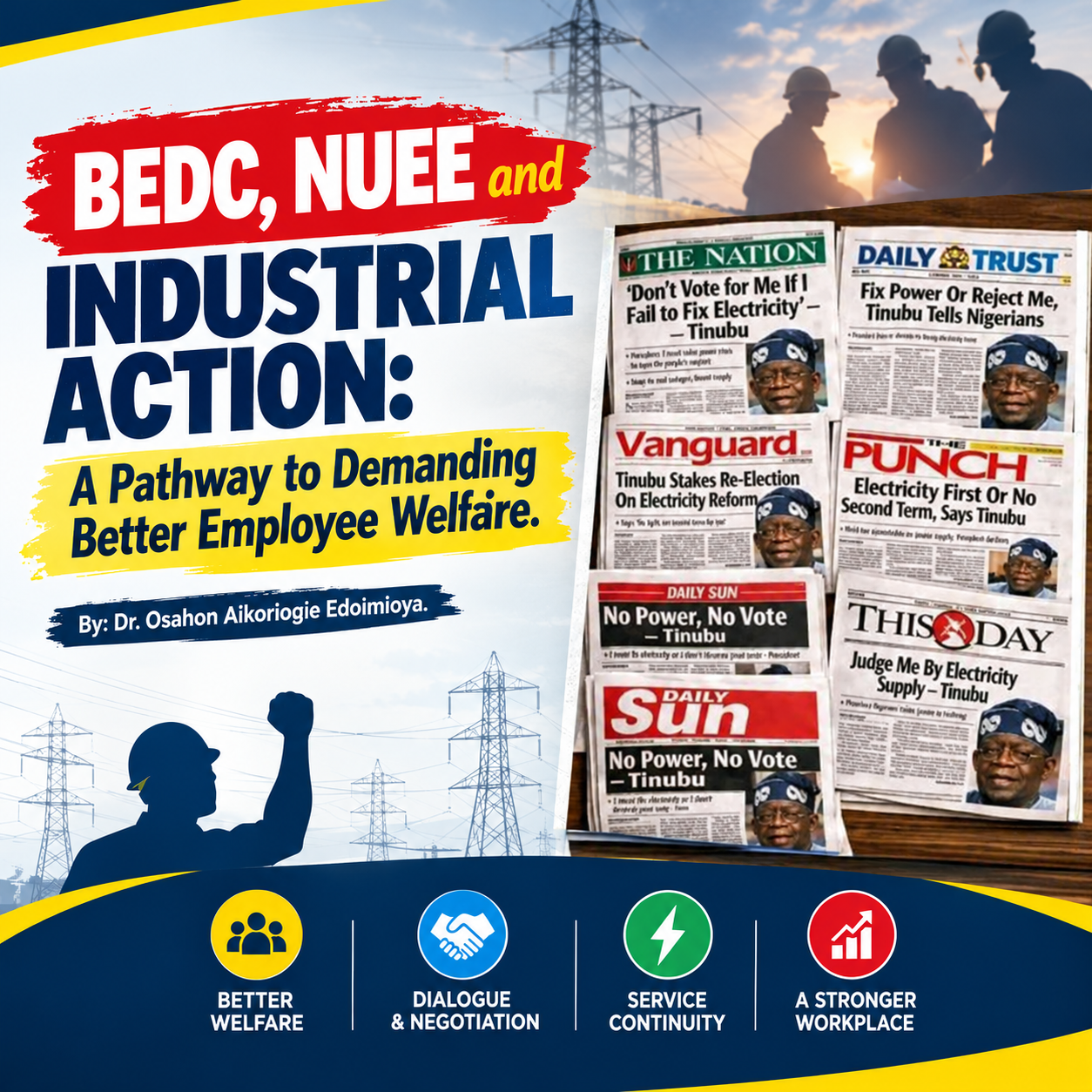
By: Dr. Osahon Aikoriogie Edoimioya.
Industrial action is one of the legitimate means through which workers, acting collectively through their unions, can draw the attention of employers to unresolved grievances and demand improved working conditions. The ongoing concerns involving the Benin Electricity Distribution Company (BEDC) and its workers’ union, the National Union of Electricity Employees (NUEE), bring to the fore an important question in industrial relations. Is industrial action a necessary pathway to securing better employee welfare?
Employee welfare is a fundamental component of a productive and sustainable organisation. Workers deserve fair remuneration, a safe working environment, timely payment of entitlements, adequate welfare packages, job security, career development opportunities and respect for their dignity. When these expectations are not adequately addressed, dissatisfaction may grow, workplace morale may decline, and industrial conflict may become inevitable.
The role of NUEE in representing the interests of electricity workers is therefore significant. A trade union serves as a collective voice through which employees can negotiate with management over wages, benefits, working conditions and other employment-related concerns. Where dialogue fails to produce satisfactory results, industrial action may become a means of applying pressure on management to return to the negotiating table.
However, industrial action should not be viewed as an end in itself. Rather, it should be considered a means of achieving a clearly defined objective. The ultimate goal should be improved employee welfare, stronger industrial harmony and a more productive working relationship between management and labour.
The Importance of Industrial Action. Industrial action can remind employers that employees are not merely instruments of production but essential stakeholders in organisational success. An organisation’s financial sustainability and operational efficiency depend significantly on the commitment, competence and well-being of its workforce.
When workers believe that their concerns are ignored, collective action may become a way to demand accountability and fair treatment. Nevertheless, the decision to embark on industrial action should be informed by the circumstances of the dispute, the efforts already made to resolve it, the seriousness of the grievances and the likely consequences for all stakeholders.
In the case of BEDC and NUEE, the specific demands and circumstances surrounding the industrial action should be clearly communicated to the public. This will enable stakeholders to understand the issues at stake without relying on speculation or unverified claims.
While workers have legitimate interests to protect, management also has a responsibility to ensure organisational stability, service continuity and financial sustainability. Consequently, both parties must recognise that prolonged industrial conflict can create difficulties for employees, the organisation and electricity consumers.
For BEDC management, constructive engagement with NUEE should be prioritised. Genuine negotiations, transparent communication and a willingness to address legitimate grievances can help prevent avoidable industrial disputes. Similarly, the union should pursue its demands through responsible representation, lawful procedures and a commitment to finding a sustainable resolution.
The objective should not be for management or the union to humiliate the other party. Rather, the objective should be to achieve a mutually acceptable agreement that protects employees’ welfare while supporting the continued delivery of essential electricity services.
Industrial disputes within the electricity sector can extend beyond the immediate parties. Electricity consumers may experience service-related difficulties, businesses may face operational challenges, and workers themselves may suffer financial losses during prolonged industrial action.
These consequences make timely resolution particularly important. Management and the union must therefore recognise their shared responsibility to minimise hardship while addressing the substantive issues that led to the dispute.
A responsible resolution should be based on clear commitments, agreed timelines and effective implementation. Where agreements are reached, both parties must honour their obligations to rebuild trust and prevent a recurrence of the conflict.
The BEDC–NUEE industrial dispute provides an opportunity to reflect on the importance of constructive industrial relations in Nigeria’s electricity sector. Although industrial action may be a necessary instrument for pressing legitimate demands when negotiations fail, its real value lies in the improvements it achieves for workers and the organisation.
The welfare of employees should never be treated as an unnecessary expense; it is an investment in productivity, loyalty, organisational stability and service delivery.
BEDC management and NUEE should therefore pursue a resolution that places fairness, dialogue, accountability and mutual respect at the centre of their engagement. Workers deserve to have their legitimate concerns heard and addressed, while electricity consumers deserve reliable services and minimal disruption.
Ultimately, the true measure of successful industrial action is not the duration of a strike or the intensity of a confrontation, but whether it produces meaningful improvements in employee welfare and establishes a more equitable and harmonious workplace.
A peaceful workplace is not achieved by silencing workers’ grievances; it is achieved by listening to them, negotiating in good faith and honouring agreements.
About The Author