By: Dr. Dennis Osahon Aikoriogie Edoimioya
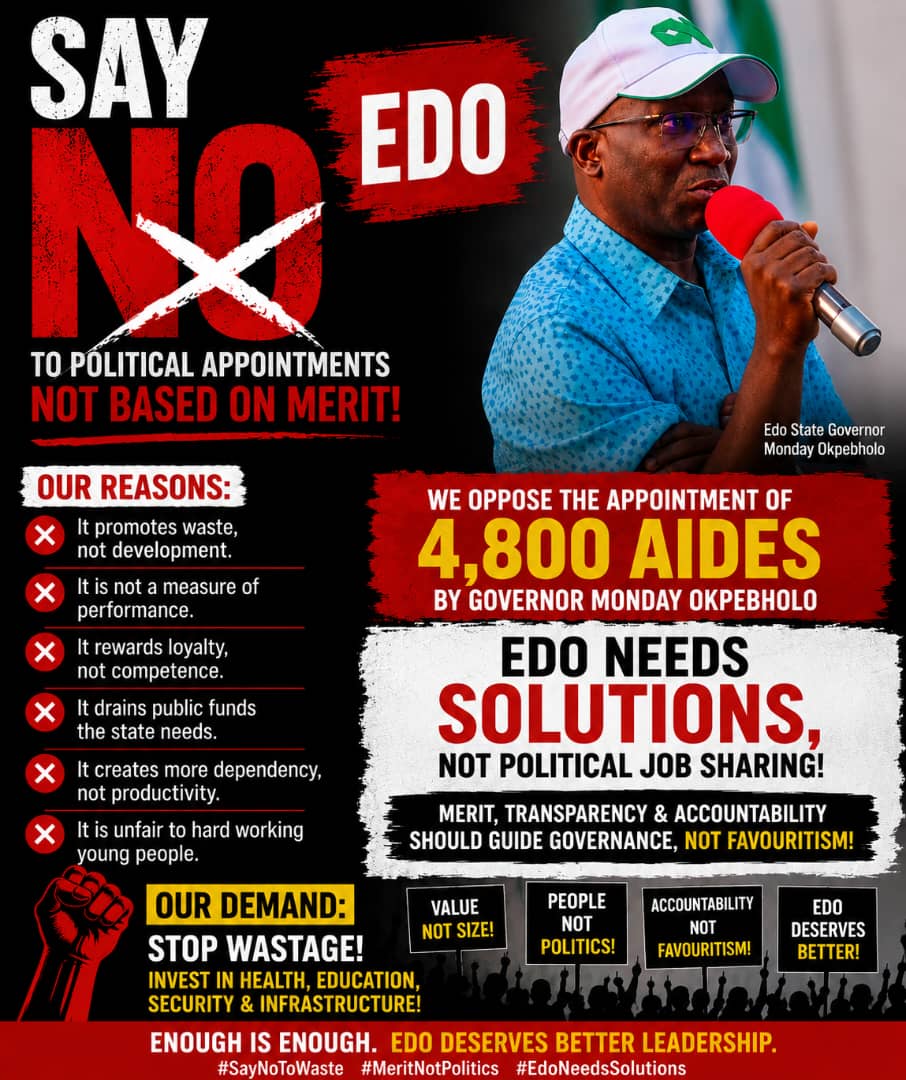
The reported appointment of 4,800 Special Assistants by the Edo State Government under Senator Monday Okpebholo is not merely an issue of numbers; it is a fundamental question about the direction, priorities and philosophy of governance in Edo State.
At a time when Edo is crying out for economic transformation, industrialisation, quality healthcare, functional education, employment opportunities, improved roads, agricultural development, security and sustainable investment, the government appears to be expanding the political appointment structure to an extraordinary scale.
This is not the governance Edo deserves.
Governance is not measured by the number of people a governor can appoint. Governance is measured by the number of lives that are transformed, businesses that are created, roads that are constructed, hospitals that function, schools that produce competitive graduates and young people who obtain sustainable employment.
4,800 APPOINTMENTS: WHAT IS THE GOVERNMENT’S PRIORITY?
The people of Edo State deserve to ask straightforward questions:
What specific functions will 4,800 Special Assistants perform?
What measurable value will each category of appointment add to the people of Edo State?
What is the total financial implication to the state?
What are their salaries, allowances, logistics and other recurrent costs?
What are their terms of reference and performance indicators?
And most importantly:
How many permanent jobs could the resources committed to this political structure create for unemployed Edo youths?
These are legitimate questions in a democracy.
The opposition is not against the appointment of competent aides where such appointments are genuinely necessary. The issue is scale, justification, transparency and opportunity cost.
A government struggling with economic development cannot afford to confuse political mobilisation with economic empowerment.
THE GOVERNMENT MUST CHOOSE BETWEEN PATRONAGE AND PRODUCTIVITY
Edo State does not suffer from a shortage of political appointees. Edo suffers from a shortage of economic opportunities and productive investments.
Our young people need industries.
They need technology and innovation hubs.
They need vocational training.
They need access to affordable capital.
They need agricultural value chains that can turn farmers into entrepreneurs.
They need functional hospitals.
They need quality schools.
They need roads that connect communities to markets.
They need security that allows businesses to operate.
They need an economy capable of creating wealth beyond government payrolls.
Therefore, when thousands of political appointments become a dominant feature of government, the opposition has a responsibility to ask whether government is building an economy or building a political structure.
PUBLIC MONEY MUST SERVE THE PUBLIC INTEREST
The Edo State Government itself has previously emphasized the importance of merit, due process and accessible employment. In November 2024, the administration announced a suspension of recruitment into the state civil service and ordered a review of appointments, citing the need for employment to be merit-based, competitive and accessible to Edo indigenes.
That makes the present debate even more important.
If government can scrutinise conventional employment because of concerns about due process and public resources, then large-scale political appointments must equally be subjected to rigorous transparency and accountability.
The people have a right to know the difference between a legitimate administrative necessity and political patronage.
THE REAL MEASURE OF GOVERNMENT IS NOT THE NUMBER OF AIDES
A governor does not receive a mandate to distribute appointments.
A governor receives a mandate to govern.
The real scorecard should therefore be:
– How many sustainable jobs have been created?
– How many industries have been attracted to Edo?
– How much has the state’s productive capacity increased?
– How many kilometres of roads have been rehabilitated and maintained?
– How have primary healthcare facilities improved?
– What measurable improvement has occurred in public schools?
– How much private investment has actually entered the state?
– What has been done to reduce poverty and youth unemployment?
– What is the security situation across Edo communities?
– What is the return on every naira of public expenditure?
These are the questions that should dominate public discourse, not the size of the governor’s political appointment list.
APPOINTMENTS CANNOT SUBSTITUTE FOR DEVELOPMENT
The people of Edo State cannot eat political appointments.
They cannot drive appointments on bad roads.
Appointments cannot replace functioning hospitals.
Appointments cannot put food on the table of unemployed young graduates.
Appointments cannot transform an economy.
Appointments cannot attract investors unless they are accompanied by infrastructure, security, policies and a productive business environment.
Therefore, the Okpebholo administration must explain why the state requires such an enormous number of Special Assistants and demonstrate, with evidence, how this structure contributes directly to economic development.
THE OPPORTUNITY COST IS TOO IMPORTANT TO IGNORE
Every naira committed to recurrent political administration is a naira that cannot simultaneously be spent elsewhere.
That is the principle of opportunity cost.
If thousands of appointments consume significant public resources, Edo people must be able to determine what developmental outcomes they are receiving in return.
Could those resources support technical education?
Could they support small and medium-sized enterprises?
Could they improve rural roads?
Could they strengthen primary healthcare?
Could they support agricultural processing?
Could they help young entrepreneurs access productive capital?
Could they attract investment into manufacturing and technology?
Those are the choices that responsible governance requires.
Edo NEEDS A PRODUCTION-BASED GOVERNMENT
Edo cannot permanently depend on government appointments as its principal mechanism for distributing economic opportunities.
That model is neither sustainable nor transformational.
What Edo needs is a government that creates the conditions under which 4,800 people can become employers rather than appointees.
Imagine 4,800 young Edo entrepreneurs running viable businesses.
Imagine 4,800 skilled workers employed in manufacturing, agriculture, construction, technology and creative industries.
Imagine thousands of additional indirect jobs created through productive investment.
That is the difference between political empowerment and economic empowerment.
OUR MESSAGE TO GOVERNOR OKPEBHOLO
Senator Monday Okpebholo was elected to govern the entire Edo State, not merely to satisfy political supporters.
The people of Edo deserve a government that places development before political patronage, productivity before bureaucracy, transparency before secrecy and economic empowerment before appointment politics.
If the 4,800 Special Assistants are genuinely necessary, then the government should publish the structure, functions, remuneration framework, funding implications and measurable performance expectations attached to the appointments.
Let the numbers speak. Let the figures be audited. Let the results be measured.
The opposition will not accept the argument that appointing thousands of political aides automatically constitutes governance.
Governance is not the multiplication of offices; governance is the multiplication of opportunities.
Leadership is not the ability to appoint thousands of people; leadership is the ability to create an economy in which thousands of people no longer need government appointments to survive.
Edo State needs factories, not inflated political structures.
Edo needs jobs, not job titles.
Edo needs investment, not endless political appointments.
Edo needs production, not patronage.
Edo needs accountable governance, not an administration whose greatest visible achievement risks becoming the size of its appointment list.
The people of Edo must therefore demand answers: 4,800 Special Assistants appointed to do what, at what cost, with what measurable benefit to the people?
Until those questions are satisfactorily answered, the massive appointment structure will continue to raise legitimate concerns that government is prioritising political patronage over economic transformation.
Edo State deserves better.
Edo people deserve accountability.
Edo deserves governance,not patronage disguised as governance.
About The Author