

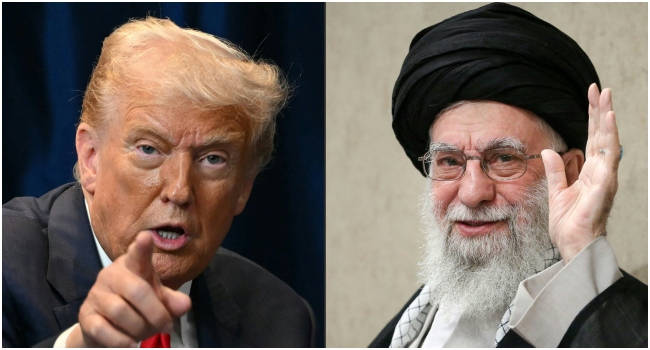
Senior Iranian officials on Sunday pledged to avenge the killing of Supreme Leader Ali Khamenei, declaring a new wave of strikes on US military bases across the Gulf despite stern warnings from US President Donald Trump of unprecedented military force.
Explosions echoed across Tehran as large crowds gathered in the capital. The Israeli military said it was again striking targets in the heart of the city, while additional blasts were reported in Jerusalem, Riyadh, Dubai, Doha and Manama.
Iran’s President Masoud Pezeshkian described Khamenei’s killing as a “declaration of war against Muslims,” insisting that Iran had a legitimate right to retaliate against those responsible for what he called a historic crime.
Ali Larijani, head of Iran’s Supreme National Security Council, warned that the country’s armed forces would deliver “an unforgettable lesson” to what he termed international oppressors. In a social media post echoing Trump’s combative style, he declared that after missile strikes on US and Israeli targets, Iran would escalate with force “never experienced before.”
Smoke was seen rising from parts of northern Tehran following fresh explosions, though it was unclear what had been targeted.
Threats of Unprecedented Force
Earlier, some Iranians were seen cheering initial reports of Khamenei’s death, but pro-government demonstrations soon followed state confirmation, with crowds chanting “Death to America!”
As calls for revenge intensified and Iran’s military announced strikes on US bases in the Gulf and Iraqi Kurdistan, Trump warned he would respond with force “never seen before” and urged Iranians to rise up against their leaders.
Iran’s first round of retaliatory attacks reportedly struck every Gulf state except Oman, which had been mediating US-Iran talks. However, on Sunday, two drones hit Oman’s commercial port in Duqm, injuring a foreign worker, while a tanker off its coast was also struck, according to Omani authorities.
The fallout from Saturday’s coordinated US and Israeli strikes — which reportedly killed the 86-year-old Khamenei and other senior officials — spread beyond Iran. In Iraq and Pakistan, angry crowds attempted to storm US diplomatic facilities.
In Karachi, at least eight people were killed during pro-Iran protests at the US consulate, according to a spokesman for the Edhi Foundation, who said most victims had suffered bullet wounds.
Iran’s Red Crescent reported that domestic strikes had left 201 people dead and hundreds injured.
The judiciary confirmed the deaths of senior figures including Ali Shamkhani, a key adviser to Khamenei, and General Mohammad Pakpour of the Revolutionary Guards.
Iran responded with missile and drone attacks across the region, killing at least two people in Abu Dhabi and one in Tel Aviv, before launching further strikes after confirming Khamenei’s death.
Uncertainty Over Succession
Speculation had already been mounting over who would succeed Khamenei given his age. Analysts believe the Revolutionary Guards could gain greater influence during the transition, given their entrenched role in Iran’s political and economic systems.
State television said Pezeshkian and two other senior officials would oversee a transitional leadership period.
Meanwhile, exiled opposition figure Reza Pahlavi, son of Iran’s last shah, welcomed the news, declaring that the Islamic Republic had effectively reached its end. He argued that any successor emerging from within the current system would lack legitimacy.
Pahlavi, who has long positioned himself as a potential transitional leader toward a secular democracy, remains a divisive figure within Iran’s broader opposition movement.
Separately, Iran’s judiciary said a strike on a school in the country’s south killed 108 people on Saturday, though independent verification of the claim was not immediately possible.

