

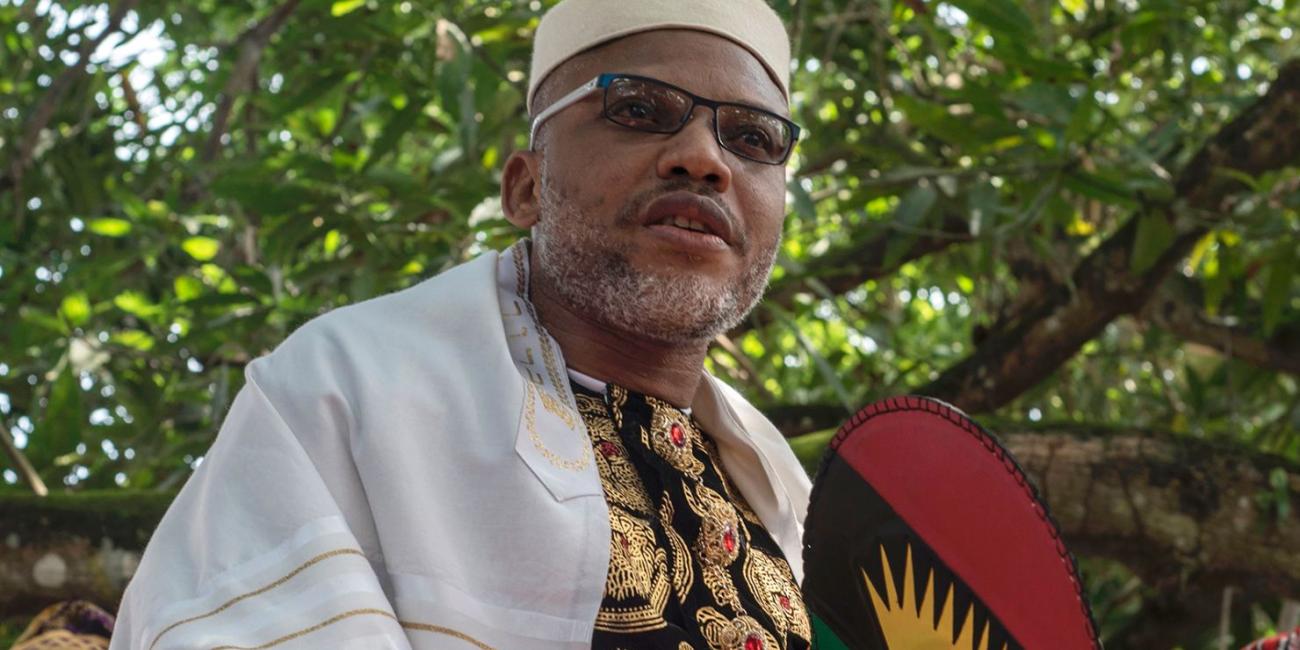
Security has been intensified across Nigeria’s South-East region ahead of today’s judgment in the terrorism trial of Nnamdi Kanu, leader of the Indigenous People of Biafra (IPOB). The Federal High Court in Abuja is set to rule on the case after nearly a decade of legal proceedings.
Kanu, who has been held by the Department of State Services (DSS) since June 2021 following what his lawyers describe as an “extraordinary rendition” from Kenya, is awaiting the court’s decision on whether the charges against him will stand.
Justice James Omotosho of the Federal High Court had fixed November 20 for judgment after ruling that Kanu failed to present his defence within the six days allocated to him. Kanu had previously challenged the validity of the terrorism charges, arguing that the now-repealed Terrorism Prevention and Prohibition Act rendered them unlawful. He sought to have the case struck out, his “not guilty” plea expunged, and his release ordered.
However, Justice Omotosho ruled that Kanu could not claim a denial of fair hearing after failing to make use of the opportunity granted, adding that no ruling or preliminary objection would be considered at this stage.
Kanu’s legal battle has been marked by multiple adjournments, appeals, and counter-applications. In October 2022, the Court of Appeal discharged him, ruling that his rendition from Kenya violated international law. The Federal Government appealed, and the Supreme Court later reversed the decision, returning the case to the trial court.
His detention has attracted national and international attention, with several Igbo groups, human-rights organisations, and political leaders from the South-East calling for his release as a step toward reducing regional insecurity. Kanu has also filed a fresh suit at the Court of Appeal seeking to halt today’s ruling, though the appellate court has not yet scheduled a hearing.
Ahead of the verdict, security agencies in Abia State, Kanu’s home state, have ramped up measures to prevent any breakdown of law and order. Police Public Relations Officer ASP Maureen Chinaka stated that the state Commissioner of Police, Danladi Isa, confirmed that “Abia remains peaceful,” while the command has placed additional security coverage statewide.
“We put some security strategies in place to make sure there is no breakdown of law and order,” Isa said. Chinaka added that security patrols are a routine feature, taking place every Monday, and the command does not anticipate any unrest regardless of the court’s decision.
Meanwhile, Kanu recently filed a direct criminal complaint against two DSS witnesses, identified in court as TAA (PW1) and BBB (PW2), accusing them of giving false testimony under oath. The complaint, filed at a Chief Magistrate’s Court in Abuja on November 13, also lists the Attorney General of the Federation, Lateef Fagbemi (SAN), and the DSS Director-General, Adewale Adeleye or his successor, as defendants.
Kanu alleged that the witnesses knowingly provided false evidence between May and July 2025, contradicting affidavits and public records regarding his detention and the handling of his statements. He claimed their testimonies sought to obscure the true chain of custody of his recorded statements.
As the nation awaits the verdict, tension remains high over a trial widely regarded as one of Nigeria’s most politically sensitive in recent years.

