

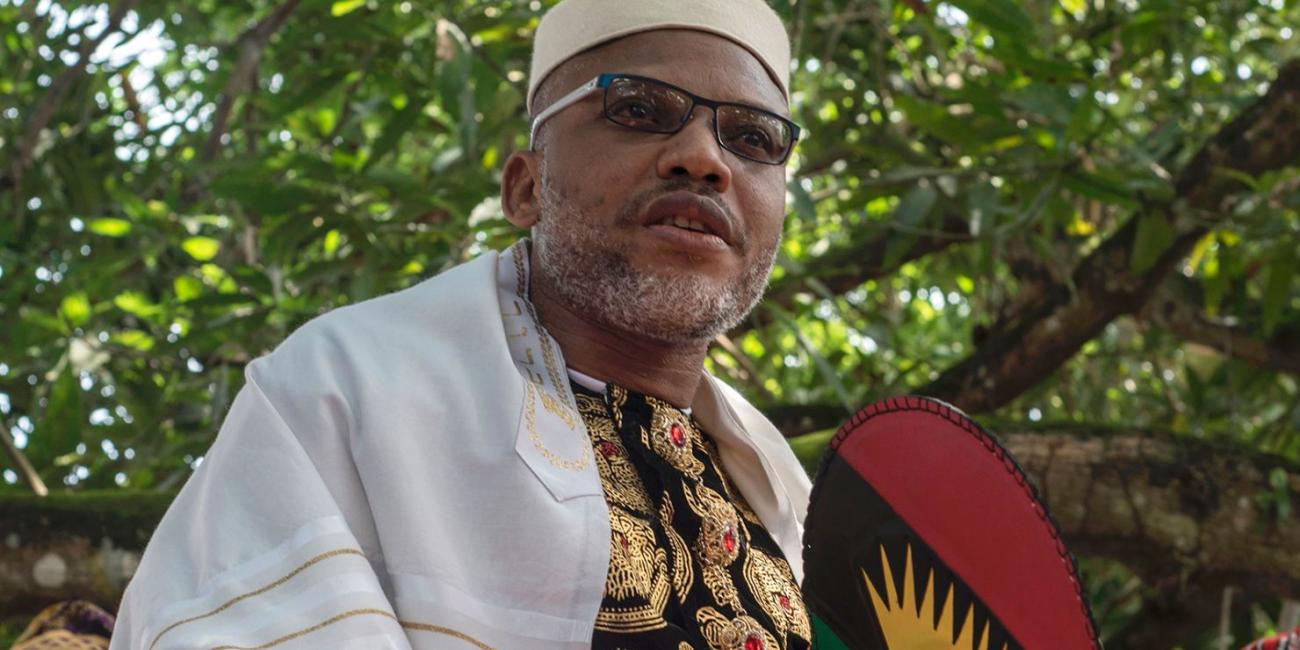
The Federal High Court in Abuja on Monday convicted the detained leader of the Indigenous People of Biafra (IPOB), Nnamdi Kanu, on count one of the terrorism charges filed against him.
Justice James Omotosho held that the prosecution’s evidence stood unchallenged since Kanu neither presented a defence nor offered any explanation to counter the allegations.
Delivering the ruling, the judge said:
“This court, therefore, holds that the prosecution has established count one beyond reasonable doubt. Consequently, the defendant is hereby convicted in respect of count one.”
Kanu had earlier been removed from the courtroom after repeatedly interrupting proceedings, which the court described as persistent unruly behaviour. The judge ruled that the trial — including delivery of judgment — would continue in his absence.
Tension in Court as Kanu Challenges Court’s Authority
The courtroom atmosphere had grown tense shortly after the judge dismissed Kanu’s latest bail application.
Visibly agitated, Kanu protested the ruling and demanded that the court show him the legal basis for refusing him bail during trial.
“Show me the law, Justice Omotosho. Show me the law. Any judgement from this court is a kangaroo one. It is premeditated,” Kanu shouted.
Justice Omotosho repeatedly urged him to remain calm and assured him that he retained the right to appeal the decision.
When Kanu refused to back down, the judge ordered security operatives to remove him from the courtroom.
Dispute Over Final Written Address
In another dramatic moment, Kanu insisted he had not forfeited his constitutional right to present a final written address, contrary to the court’s earlier ruling.
Justice Omotosho had previously held that the defence had already filed its final address after being granted six days to open its case — a deadline the defence failed to meet.
The confrontation escalated as Kanu repeatedly demanded to be heard, prompting security officers to prepare to escort him out.
Background: Legal Motions and Pending Appeal
Kanu recently filed a motion challenging the validity of the terrorism charges, arguing that they were grounded in a repealed version of the Terrorism Prevention and Prohibition Act. He asked the court to strike out the case, expunge his “purported” plea of not guilty, and order his release, insisting that the charges disclosed no offence known to law.
He has also filed a fresh appeal seeking to stop today’s judgment, but the Court of Appeal has not scheduled a hearing or issued any order on the request.
Justice Omotosho had earlier fixed November 20 for judgment after ruling that Kanu failed to open his defence within the allotted six days.

