

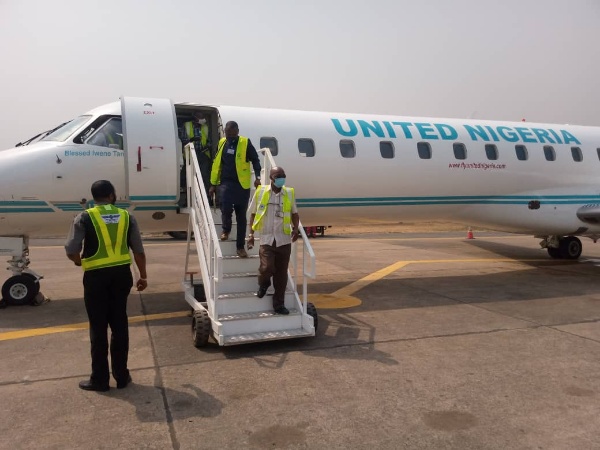
Hobnob News – Nigeria’s aviation industry is facing renewed turbulence as airline operators and key stakeholders, both local and international, have rejected the Federal Government’s plan to impose fresh taxes on scheduled airlines under the Nigeria Tax Act 2025.
Operators warn that the new measures could cripple the sector, already struggling with record-high operational costs and skyrocketing ticket prices.
The concerns were raised during a Business Webinar held on Thursday with the theme “Nigeria Tax Act (2025) and the Aviation Industry.” The event, monitored by Hobnob News, saw strong opposition led by Dr. Samson Fatokun, Area Manager for West and Central Africa at the International Air Transport Association (IATA).
Stakeholders argued that the industry is already weighed down by multiple charges, including Passenger Service Charge, Ticket Sales Tax, Cargo Sales Charge, a five per cent levy on all aviation contracts, and a $20 security fee. In addition, the recently introduced Advance Passenger Information System (APIS) imposes $11.50 per passenger per flight leg.
As a result, domestic airfares have doubled in the past year, forcing many Nigerians to opt for road travel instead of air.
Capt. Edward Boyo, Managing Director of Landover Company Limited, described the proposed reforms as “a major setback to Nigeria’s aviation growth.” He urged President Bola Tinubu and Federal Inland Revenue Service (FIRS) Chairman, Dr. Zacch Adedeji, to urgently review the policy.
“The country’s economy cannot thrive without aviation. If these tax burdens persist, operators may have no choice but to raise fares further, making air travel unaffordable for the average Nigerian,” Boyo warned.
However, Mrs. Nkechi Umegakwe, Assistant Director and Tax Policy Adviser at the FIRS, defended the new law, insisting it followed due process and was designed to boost compliance, revenue, and align Nigeria’s tax framework with global standards. She explained that starting January 1, 2026, airlines would pay Value Added Tax (VAT) on imported aircraft, spare parts, and tickets.
But Dr. Fatokun of IATA countered that the move contravenes international treaties, particularly International Civil Aviation Organisation (ICAO) rules, which exempt international air transport from taxation. He also reminded the government of the ECOWAS Supplementary Act of December 14, 2004, which prohibits taxation on air passenger and cargo transportation within member states.
“Nigeria cannot afford to breach international and regional treaties it has signed. Such actions undermine our credibility in global aviation,” Fatokun said.
Industry experts, including Capt. Samuel Caulcrick, a former Rector of the Nigerian College of Aviation Technology, cautioned that additional tax burdens could collapse domestic airlines. “The airlines are being strangled. Without relief, many operators will fold up,” he said.
Analysts warn that the implications for passengers are stark: more expensive tickets and declining connectivity. This could reverse recent gains in regional air travel, especially at a time when the African Continental Free Trade Area (AfCFTA) relies on strong aviation links.
Stakeholders unanimously urged the Federal Government to designate aviation as a “priority sector” exempt from excessive taxation, stressing its role in driving economic growth, investment, and regional integration.
As the January 2026 implementation date approaches, Nigeria’s aviation industry remains at a crossroads—caught between government fiscal reforms and the urgent call to preserve an already fragile sector.

