

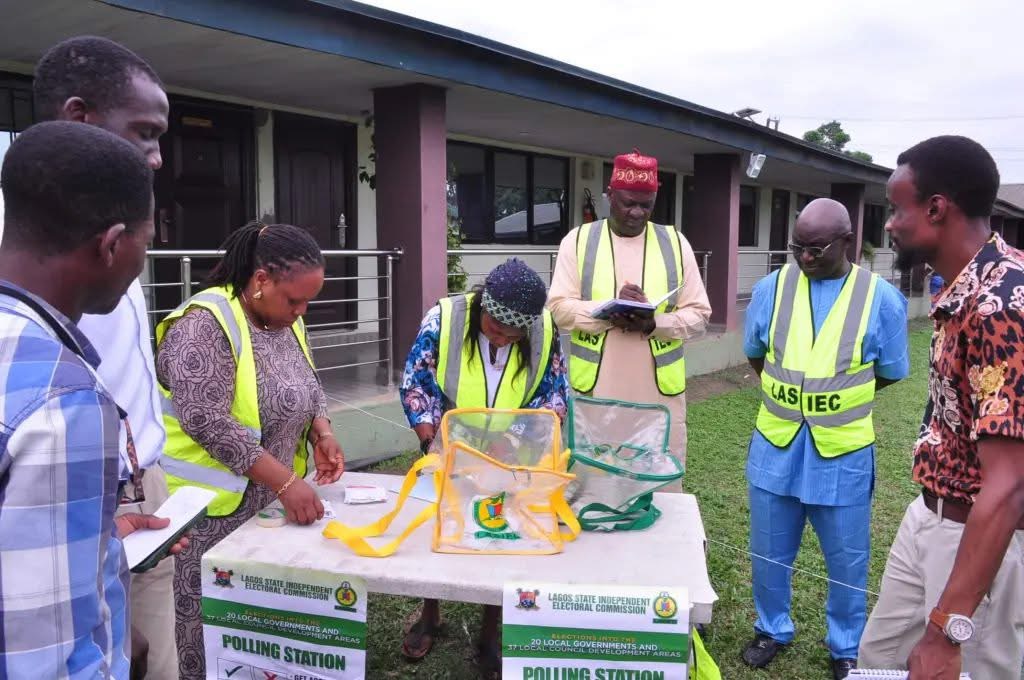
All is now set for the Lagos State Local Government Council elections scheduled to hold today, Saturday, July 12, 2025.
From the mainland to the islands, anticipation hangs in the air as political actors, election observers, and residents brace for what many consider a quiet yet significant test of the state’s political landscape.
The Lagos State Independent Electoral Commission (LASIEC) has released the final list of validated candidates contesting for chairmanship and councillorship positions across the state’s 20 Local Government Areas (LGAs) and 37 Local Council Development Areas (LCDAs). Voting is expected to commence by 8 a.m., with security operatives and election materials reportedly deployed across the 13,325 designated polling units.
Though local government elections in Nigeria are often characterized by low voter turnout and limited national media attention, today’s poll in Lagos carries added political weight. It comes at a critical juncture as the ruling All Progressives Congress (APC) seeks to consolidate its grip at the grassroots level, following opposition gains recorded during the 2023 general elections.
Political analysts view the exercise as a litmus test for Governor Babajide Sanwo-Olu’s leadership and, by extension, the enduring influence of President Bola Ahmed Tinubu in his home state.
Unsurprisingly, the APC remains the party to beat, buoyed by a vast grassroots structure that has kept it in power in Lagos since 1999. Its candidates are fielded across all LGAs and LCDAs, making it the most dominant political force on the ballot.
However, the Labour Party (LP), buoyed by its surprise performance in the 2023 presidential election—especially in areas such as Amuwo-Odofin, Eti-Osa, and Surulere—is hoping to convert its momentum into local wins. LP candidates have campaigned actively in selected areas, though their visibility remains inconsistent across the state.
The once formidable Peoples Democratic Party (PDP), now grappling with internal rifts and dwindling public relevance, has made a muted showing in the run-up to the elections.
Civil society groups and opposition figures have raised concerns about the preparedness of LASIEC, particularly over the delayed publication of the final list of candidates, which was only made public on July 8—just four days before the vote.
Several opposition candidates, particularly from the Labour Party, have also decried acts of intimidation, destruction of campaign materials, and fears of possible manipulation. In Amuwo-Odofin, one LP candidate alleged a plot to disrupt the process and called on security agencies to intervene.
In response, LASIEC Chairperson, Justice Ayotunde Phillips (rtd.), assured voters that all necessary arrangements have been made to ensure a transparent and credible election. She emphasized the commission’s commitment to inclusivity, stating that provisions had been made for elderly voters, pregnant women, and persons with disabilities.
Governor Babajide Sanwo-Olu has called on residents to come out en masse, stressing the importance of the local government tier in delivering essential services and fostering grassroots development.
The Lagos State Police Command and other security agencies have also pledged a peaceful process, promising the deployment of personnel to ensure safety and order at every polling unit.
While often overshadowed by national polls, local government elections are pivotal. They determine who controls development funds at the grassroots, who governs local markets and schools, and who positions for influence in the lead-up to the 2027 general elections.
Stay with Hobnob News for real-time updates and live reports from our correspondents across all 57 local councils of Lagos State.

