

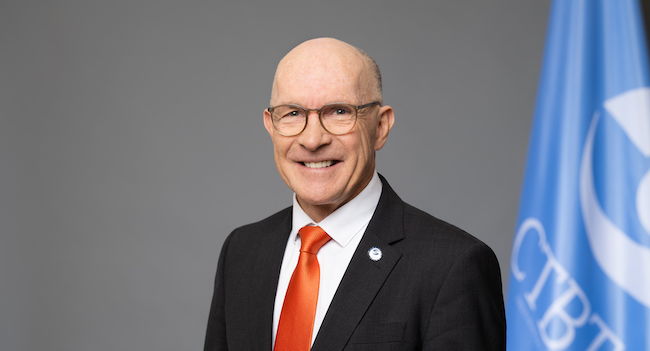
The Executive Secretary of the Comprehensive Nuclear-Test-Ban Treaty Organisation (CTBTO), Dr. Robert Floyd, has sounded the alarm over increasing global rhetoric around the potential use and resumption of nuclear weapons testing—a shift he described as “dark clouds” looming over international peace and security.
Speaking in Lagos on Thursday during a lecture titled “The Comprehensive Nuclear Test Ban Treaty as a Model of Multilateral Success: What it Means for Africa, Today and Tomorrow,” Floyd cautioned that language suggesting the actual use of nuclear weapons, rather than mere deterrence, is on the rise—a dangerous shift that threatens global stability.
“Before now, nuclear weapons were kept purely for deterrence. But now, we’re hearing threats of actual use. That is extremely dangerous,” he said at the Nigerian Institute of International Affairs (NIIA). “This language has no place in our world. It undermines decades of global efforts toward peace.”
Floyd identified nuclear war and climate change as the two most pressing existential threats confronting humanity today. He praised the Comprehensive Nuclear-Test-Ban Treaty (CTBT) as a global success, despite current geopolitical tensions.
Signed in 1996, the CTBT bans all nuclear explosions—whether military or civilian—across all environments, including land, sea, air, and underground. It has so far been signed by 187 countries and ratified by 178, yet nine nations remain outside the framework, including North Korea, India, Pakistan, and Saudi Arabia. Another 18 countries, such as the United States, Russia, China, Israel, and Iran, have signed but not ratified the treaty.
While emphasizing that those countries may not necessarily oppose the treaty, Floyd urged global leaders to prioritize full ratification for the sake of global peace. “Nuclear war has no winners—only devastation. Diplomacy must prevail,” he warned.
Floyd applauded Africa’s proactive stance, noting that 52 of the continent’s 54 nations have signed the CTBT, positioning the region as a beacon of nuclear responsibility. “Africa is leading by example. A nuclear-free Africa protects not just the continent, but the world,” he said.
The CTBTO chief encouraged African nations to harness the peaceful applications of nuclear science, particularly in electricity generation, healthcare, and environmental protection. “The treaty benefits everyone—large or small—because global safety is a shared asset,” Floyd added.
A key highlight of his lecture was the International Monitoring System (IMS) maintained by the CTBTO—a powerful global surveillance network of 321 monitoring stations and 18 laboratories across 89 countries, capable of detecting nuclear detonations, natural disasters such as earthquakes, volcanic eruptions, and even meteor strikes.
“Our system detected events during the Iran-Israel conflict and will remain a cornerstone for accountability, even in a world free of nuclear weapons,” Floyd explained.
He concluded with a message to the younger generation: “The world we leave behind is in your hands. Stay focused. Protect the climate. Uphold peace. And honour the legacy of those who fought to make this treaty a reality.”
The event was chaired by Prof. Femi Otubanjo, a research professor at NIIA, with Prof. Eghosa Osaghae, Director-General of the institute, delivering the opening remarks.

