

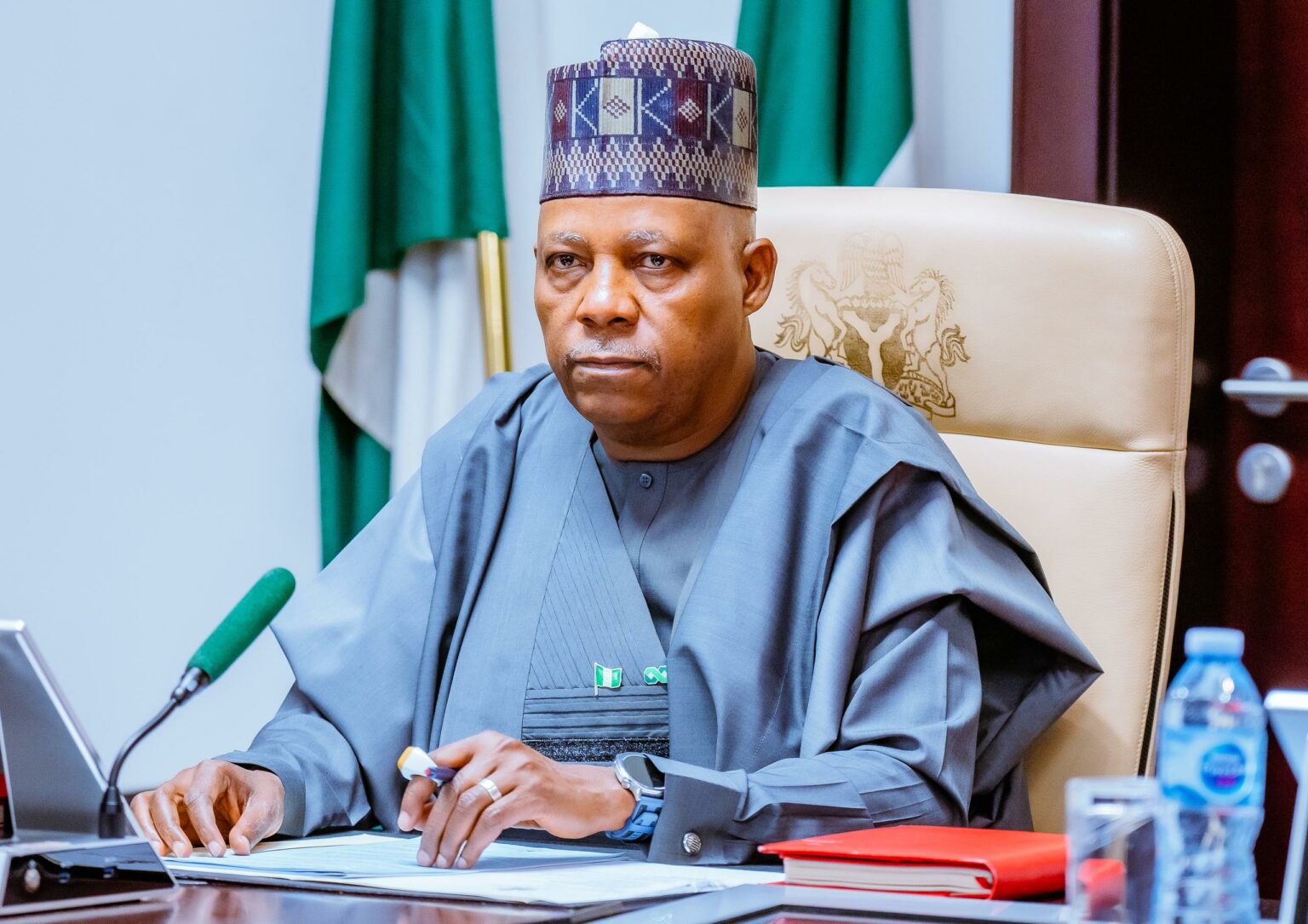
Vice President Kashim Shettima has reflected on his turbulent political journey, revealing that he was the most vilified public figure during the final years of former President Goodluck Jonathan’s administration.
Shettima made this revelation in Abuja on Thursday during the public presentation of “OPL 245: Inside Story of the $1.3bn Nigeria Oil Block”, a book authored by former Attorney General of the Federation and Minister of Justice, Mohammed Adoke.
“In the last four years of former President Goodluck Jonathan’s administration, I was the most demonised person; I was public enemy number one,” the Vice President stated.
According to Shettima, attempts were made at the highest levels of government to remove him from office as the Governor of Borno State, citing discussions held within Nigeria’s top leadership circle at the time.
He recalled a private meeting involving the former President, Vice President, Senate President, and Speaker of the House of Representatives, where Jonathan reportedly considered ousting him. However, he said it was Aminu Tambuwal, then Speaker, who boldly reminded Jonathan that such a move was unconstitutional—even against a councillor.
“The President was still not convinced and brought the idea again at a Federal Executive Council meeting,” Shettima noted.
It was at this point, he added, that Mohammed Adoke, then serving as Attorney General, firmly stood his ground, advising the President that there was no constitutional basis to remove a sitting governor.
“They also sought the opinion of another SAN, Kabiru Turaki, who concurred with Adoke. That’s how the matter was laid to rest,” Shettima said, describing the event as a defining moment that cemented his respect and bond with Adoke and Tambuwal.
He went on to commend Adoke for his strength of character, professionalism, and capacity to forgive, especially in light of the controversies surrounding his public service.
The book presentation was centered on the OPL 245 (Malabu oil deal)—a contentious $1.3 billion oil block transaction involving Royal Dutch Shell and Italy’s Eni, described as one of Nigeria’s most debated energy deals. The deep-water oil block is estimated to hold over nine billion barrels of crude oil.
Shettima’s remarks shed light on the complex intersections of politics, loyalty, and governance, while also highlighting moments of courage and legal integrity during one of Nigeria’s most scrutinised political eras.

