

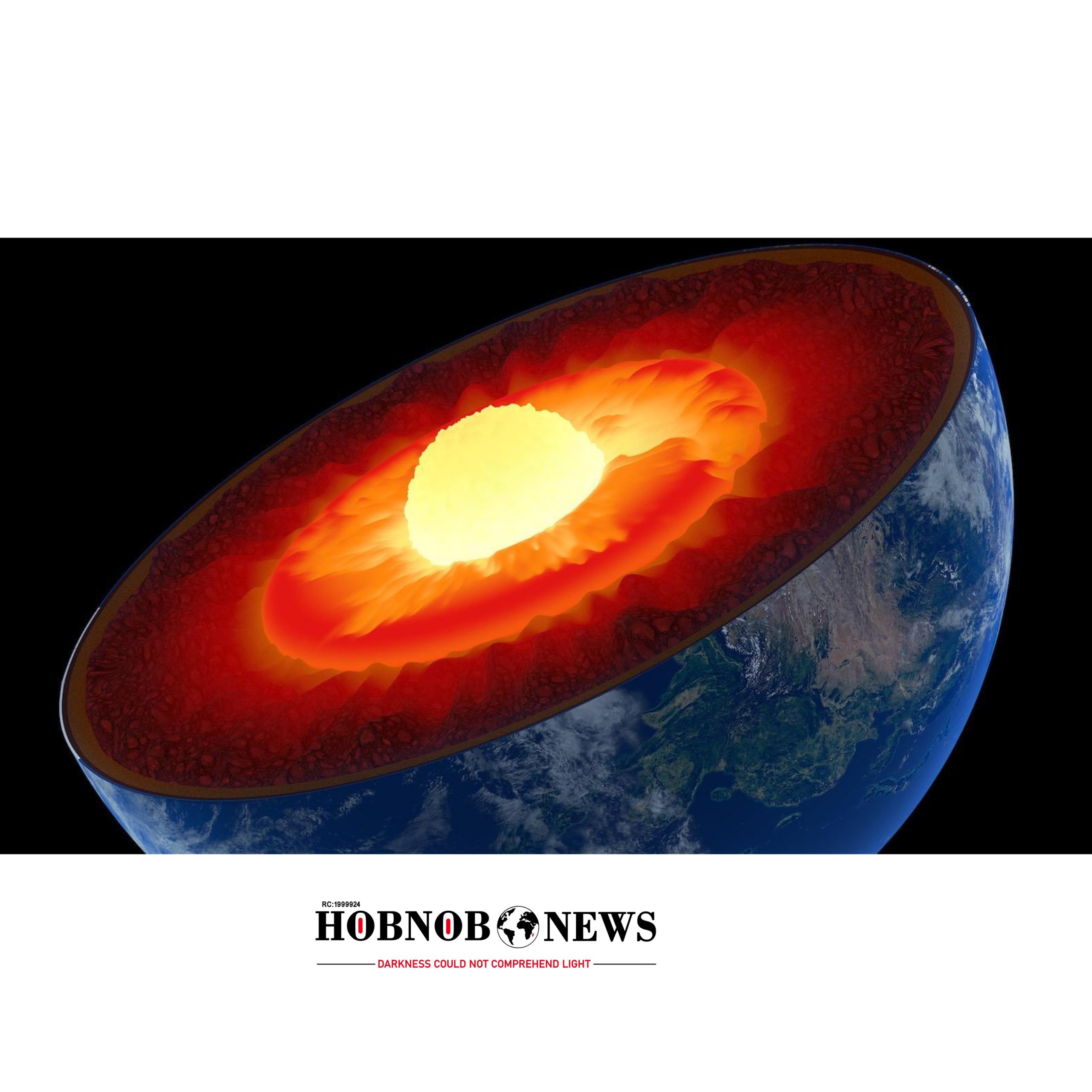
In a major breakthrough, scientists have discovered that mysterious objects are moving horizontally nearly 3,000 kilometres (1,864 miles) beneath the Earth’s surface—within a zone known as the D″ (D double-prime) layer. The findings, published in Communications Earth & Environment, provide new insight into the deep interior of the Earth and could reshape our understanding of seismic activity, tectonic motion, and the planet’s magnetic field.
The D″ layer sits at the boundary between the Earth’s mantle and its outer core and has long puzzled scientists due to its unusual behaviour. Seismic waves are known to accelerate inexplicably as they pass through this region, but until now, the reason remained unclear.
Researchers at ETH Zurich, led by Professor Motohiko Murakami, have now identified the cause. Through high-pressure, high-temperature experiments that mimic conditions at the base of the mantle, they observed that crystals of a mineral called post-perovskite align in a specific direction. This alignment affects the way seismic waves travel, allowing them to speed up when moving horizontally through the material.
“This isn’t just a geological curiosity—it’s a crucial piece of the puzzle,” said a member of the research team. “The alignment of these crystals creates anisotropy, which means that seismic waves travel at different speeds depending on their direction. This explains the long-standing mystery of wave acceleration in the D″ layer.”
Importantly, the study also confirms the presence of convection currents within the Earth’s mantle. These slow, swirling flows of solid rock—similar in behaviour to boiling water—help reorient the crystals and drive horizontal movement deep beneath the surface. This activity influences the movement of tectonic plates and contributes to the generation of the Earth’s magnetic field.
The researchers used cutting-edge laboratory techniques to replicate the extreme conditions of the D″ layer, including temperatures over 3,000°C and pressures exceeding 130 gigapascals. Under these conditions, post-perovskite forms and arranges itself in a way that affects the travel paths of seismic waves.
These findings could significantly improve the accuracy of models used to predict earthquakes and volcanic eruptions. By better understanding the inner dynamics of the planet, scientists hope to develop more reliable early warning systems and refine existing geological theories.
“This marks a new era in geophysical research,” Professor Murakami said. “It’s a reminder that even the deepest parts of our planet are constantly shifting and influencing life on the surface.”
The discovery opens new pathways for research into the Earth’s interior and supports the idea that what happens deep underground can have far-reaching effects on geological and environmental systems worldwide.

