

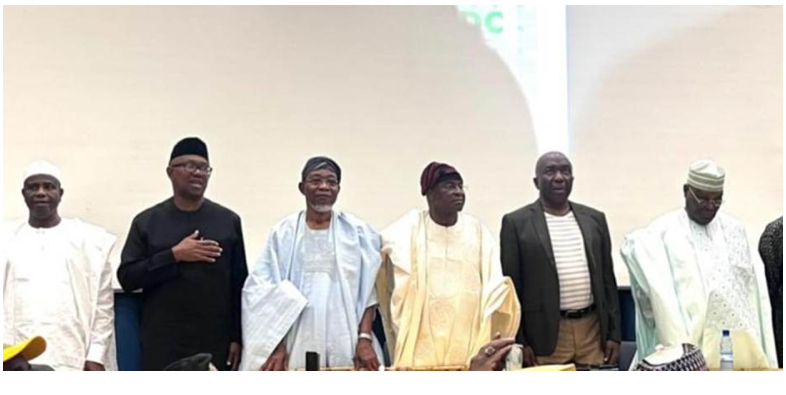
For the third time in his political career, Peter Obi, the 2023 presidential candidate of the Labour Party (LP), has defected to align with a newly formed opposition coalition that has adopted the African Democratic Congress (ADC) as its platform ahead of the 2027 general elections.
Obi, whose political journey has seen him traverse three major parties, began his rise as Governor of Anambra State under the All Progressives Grand Alliance (APGA). He later moved to the Peoples Democratic Party (PDP), where he was the vice-presidential running mate to Atiku Abubakar in the 2019 elections. In 2023, he made a strong showing as the Labour Party’s presidential flagbearer, capturing the imagination of millions of Nigerian youths with his message of a “new Nigeria.”
Now, Obi has formally joined forces with a new political coalition led by former Vice President Atiku Abubakar. The group, which seeks to wrest power from President Bola Tinubu and the ruling All Progressives Congress (APC) in 2027, announced its adoption of the ADC, with former Senate President David Mark named as National Chairman and former Osun State Governor Rauf Aregbesola as National Secretary.
In a statement posted on his 𝕏 (formerly Twitter) handle on Thursday morning, Obi described the decision to join the coalition as one borne out of “deep reflection” and national interest.
“Our commitment is to sacrifice and work together towards the 2027 General Elections, ensuring that Nigeria gets a competent, capable, and compassionate leadership,” Obi wrote. “This decision was not made lightly. It comes from deep reflection on where we are as a country and what must be done to move forward.”
However, the move has drawn immediate backlash from the Labour Party leadership, with a stern 48-hour ultimatum issued to Obi to resign his membership from the party.
In a statement dated July 3, 2025, and signed by the party’s National Publicity Secretary, Obiora Ifoh, the LP distanced itself from the new coalition, describing its members as “power mongers” lacking genuine commitment to the people.
“The new Nigeria is not achievable with an assemblage of old, recycled, desperate, and frustrated politicians,” Ifoh declared. “Desperate politicians cannot birth a new Nigeria.”
The party further accused Obi of secretly lobbying LP members to defect alongside him, warning that Labour would not tolerate “dual membership or deceptive political conduct.”
“We are not available for people with dual agenda,” the statement read. “Labour Party will not avail itself to individuals who have one leg in the party and another elsewhere.”
Despite the backlash, Obi’s move signals an intensifying realignment ahead of the 2027 elections, as opposition forces attempt to consolidate in the face of growing dissatisfaction with the APC government.
As Nigeria watches the unfolding political drama, the big question remains: Will this new coalition succeed where others have failed — or is it yet another gathering of old guard politicians chasing power under a new banner?

