

Iran launched a fierce retaliatory missile barrage against Israel on Friday, hours after a sweeping Israeli air assault struck at the heart of the Islamic Republic’s nuclear program and killed several of its top military commanders.
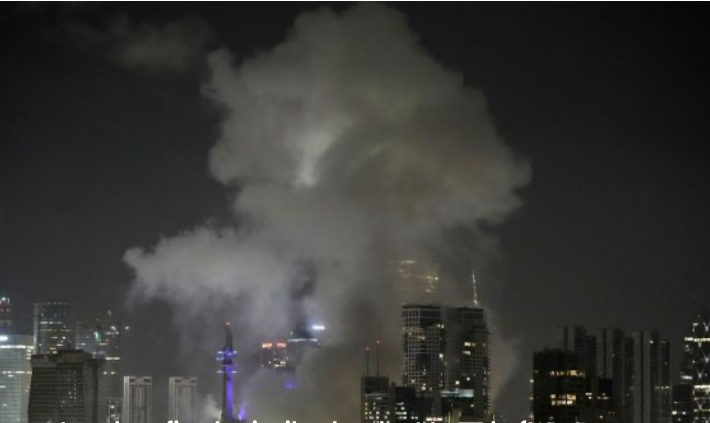
Explosions and air raid sirens echoed across central Israel as Iranian ballistic missiles rained down, with smoke rising over Tel Aviv’s skyline. Iranian state media said the Islamic Revolutionary Guard Corps (IRGC) had targeted dozens of sites across Israel, including military and intelligence installations.
The strikes were a direct response to what Iran described as a “blatant act of war” — an Israeli offensive that reportedly killed top IRGC leadership and destroyed critical parts of Iran’s nuclear infrastructure, including facilities at Natanz. According to Iranian sources, six nuclear scientists were among the dead, alongside Armed Forces Chief of Staff Mohammad Bagheri and IRGC Commander Hossein Salami.
“The armed forces of the Islamic Republic will inflict heavy blows upon this malevolent enemy,” Iran’s Supreme Leader Ayatollah Ali Khamenei vowed in a national address, promising to bring Israel “to ruin.”
Israeli Prime Minister Benjamin Netanyahu confirmed the earlier strikes on Iranian territory, declaring that Israel had “struck at the heart of Iran’s nuclear enrichment program.” He warned of “several waves” of Iranian retaliation and vowed Israeli military operations would continue “as many days as it takes.”
The Israeli military claimed intelligence indicated Iran was nearing a “point of no return” in its nuclear ambitions, prompting the preemptive strike. The attack reportedly destroyed an underground IRGC command center and eliminated most of its senior air force leadership.
Amid the escalating hostilities, the UN Security Council scheduled an emergency session for 1900 GMT at Iran’s request, supported by Russia and China. Global leaders urged restraint, but few held out hope for immediate de-escalation.
The violence sent shockwaves across the region. Iran halted flights at Imam Khomeini International Airport, while Iraq, Jordan, and Syria shut down their airspace. Israel declared a state of emergency as panic spread among civilians. In Tel Aviv, multiple explosions damaged buildings, leaving several people trapped in a high-rise, according to emergency services.
In Washington, former President Donald Trump, who had previously warned of a “massive conflict,” urged Iran to “make a deal” on its nuclear program or face “even more brutal” consequences. While emphasizing that the U.S. was not involved in the Israeli operation, the Biden administration warned Tehran not to target American assets, stating that Iran would be “held responsible for consequences.”
Despite widespread damage, Iran’s Atomic Energy Organisation claimed the main enrichment facilities at Natanz had only suffered “surface-level” damage, with radiation levels reportedly unchanged, according to the International Atomic Energy Agency (IAEA).
Global markets reacted swiftly — oil prices surged, stocks tumbled, and concerns over a broader Middle East war mounted. The conflict also threatened to derail nuclear negotiations scheduled to resume Sunday in Oman, with Trump suggesting talks were “fairly close” to progress before the strikes.
As Tehran reeled from the loss of key leaders, Ayatollah Khamenei quickly appointed replacements, vowing continuity and revenge. On the streets, anxiety gripped citizens.
“How much longer are we going to live in fear?” asked 62-year-old Ahmad Moadi. “There must be a scathing response.”
With both nations entrenched and defiant, the Middle East now stands on the precipice of a broader and potentially catastrophic war. The coming days may determine whether diplomacy can still hold — or if the region plunges into all-out conflict.

