
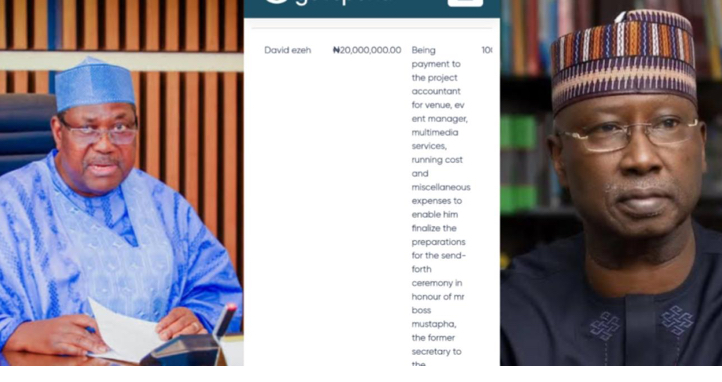
A financial review by Hobnob News Nigeria has uncovered that the Office of the Secretary to the Government of the Federation (SGF), currently headed by Senator George Akume, transferred ₦20 million of public funds into the personal bank account of one of its staff members, David Ezeh — a direct violation of Nigeria’s financial regulations.
The funds, according to data obtained from the government’s public payment tracking platform, Govspend, were used to cover expenses for a send-forth ceremony organised in honour of former SGF Boss Mustapha. The ₦20 million reportedly covered venue costs, multimedia services, miscellaneous charges, and logistics.
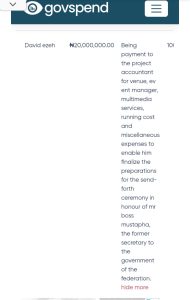
However, Chapter Seven, Section 713 of Nigeria’s Financial Regulations 2009 explicitly forbids such transactions. The regulation states: “Personal money shall in no circumstances be paid into a government bank account, nor shall any public money be paid into a private account.” It further adds: “Any officer who pays public money into a private account is deemed to have done so with fraudulent intention.”
Legal experts and civil society actors have decried the transaction as a breach of public trust. Lawyer Kehinde Awosusi, speaking with the Media, noted, “Under no circumstances should a civil servant receive government money into a personal account, whether for income or expenditure. This directly undermines the legal safeguards against financial abuse.”
Awosusi referenced the high-profile case of former Minister of Humanitarian Affairs and Poverty Alleviation, Betta Edu, who was suspended by President Bola Tinubu in January 2024 after being accused of illegally authorising the transfer of ₦585 million to a private account. The scandal led to a wider investigation by the Economic and Financial Crimes Commission (EFCC), followed by Edu’s silent removal from office in a subsequent cabinet reshuffle.
In a twist of irony, David Ezeh — the SGF staff at the centre of the latest scandal — had previously represented Akume’s office at a stakeholders’ forum in Lagos focused on enforcing the Fiscal Responsibility Act (FRA) 2007.
The controversy surrounding public fund mismanagement is not isolated. A separate Govspend review also revealed that the Federal Ministry of Arts, Culture and Creative Economy paid ₦23.8 million into the private account of one of its directors, Akudo-Nwosu Ugochi Nwakaego, for various cultural events, including the Abuja Carnival and World Culture Day celebrations. These payments were similarly in contravention of fiscal laws.
The series of infractions highlight growing concerns about weak internal controls in public finance management and disregard for regulations designed to prevent misuse of government funds.
Despite growing public scrutiny and legal provisions, enforcement remains limited. Neither the SGF’s office nor the Federal Ministry of Arts and Culture has publicly addressed the revelations, and it is unclear if the EFCC will initiate a formal probe into the latest violations.

