
A new report by Edelman, launched in Lagos on Wednesday, has revealed that seven in ten Nigerians harbour strong grievances toward the government and wealthy elites, citing inequality and selfishness as key drivers of the country’s persistent challenges. The findings were part of the 2025 Edelman Trust Barometer, a globally respected annual survey that measures public trust in major institutions across the world.
The report, titled Trust and the Crisis of Grievance, explores how Nigerians feel about institutions such as government, businesses, non-profits, and media. It also sheds light on the public’s rising frustration over perceived injustice, inequality, and a system they believe favours a privileged few.
Wandile Cindi, Senior Strategist and Reputation Advisor at Edelman Africa, said the report captures a widespread sense of betrayal. “Seven out of ten Nigerians hold grievances against the government for purposely misleading the people,” he revealed during a keynote presentation. The survey also found that 62 per cent of Nigerians believe the rich do not pay their fair share of taxes, while 74 per cent say the selfishness of wealthy individuals is the root cause of many of the country’s issues.
Cindi noted that 52 per cent of respondents now support hostile activism as a necessary means to push for national change, showing a shift in public sentiment from trust to confrontation. “The 2025 report reveals a growing crisis of grievance — a deep sense of injustice and resentment that is reshaping public perception,” he said.
The Edelman Trust Barometer, now in its 25th year, surveyed over 33,000 people across 28 countries between October and November 2024. In Nigeria, 1,150 people participated, representing diverse demographics by age, gender, and region. The report is widely referenced globally and serves as a benchmark for understanding how citizens perceive the integrity, competence, and ethics of their institutions.
Cindi pointed out that while there has been a slight improvement in public trust toward NGOs, businesses, and media, the government remains the least trusted institution in Nigeria. The government scored a net -46 for competence and -31 for ethical behaviour. These negative ratings reflect how strongly Nigerians feel about leadership failures and lack of transparency.
He added that the national trust index in Nigeria rose marginally from 61 in 2024 to 65 in 2025. However, this increase is overshadowed by deepening economic concerns and civic dissatisfaction. “There’s been a significant increase in job-related fears — from automation to offshoring,” Cindi said. “Even employers, long seen as trustworthy, are experiencing a decline in public confidence.”
According to the report, fear of discrimination is also on the rise. Seventy-five per cent of Nigerians said they were concerned about prejudice, which marks a nine-point increase from the previous year. This fear spans income groups, including high earners, indicating that even those perceived to be more secure are not insulated from systemic anxiety.
Despite these alarming statistics, Cindi believes there is still room for change. “Trust can only be rebuilt if institutions act ethically and competently,” he said. He noted that NGOs and businesses are generally viewed as ethical and competent by the Nigerian public. Therefore, they are better positioned to lead reforms in areas such as job creation, skills retraining, and information transparency.
Cindi urged leaders in all sectors to collaborate and address the sources of public grievance. “Grievance thrives when people feel left behind. Trust and optimism must become shared national goals,” he said.
Panel Discussion Highlights Collective Responsibility
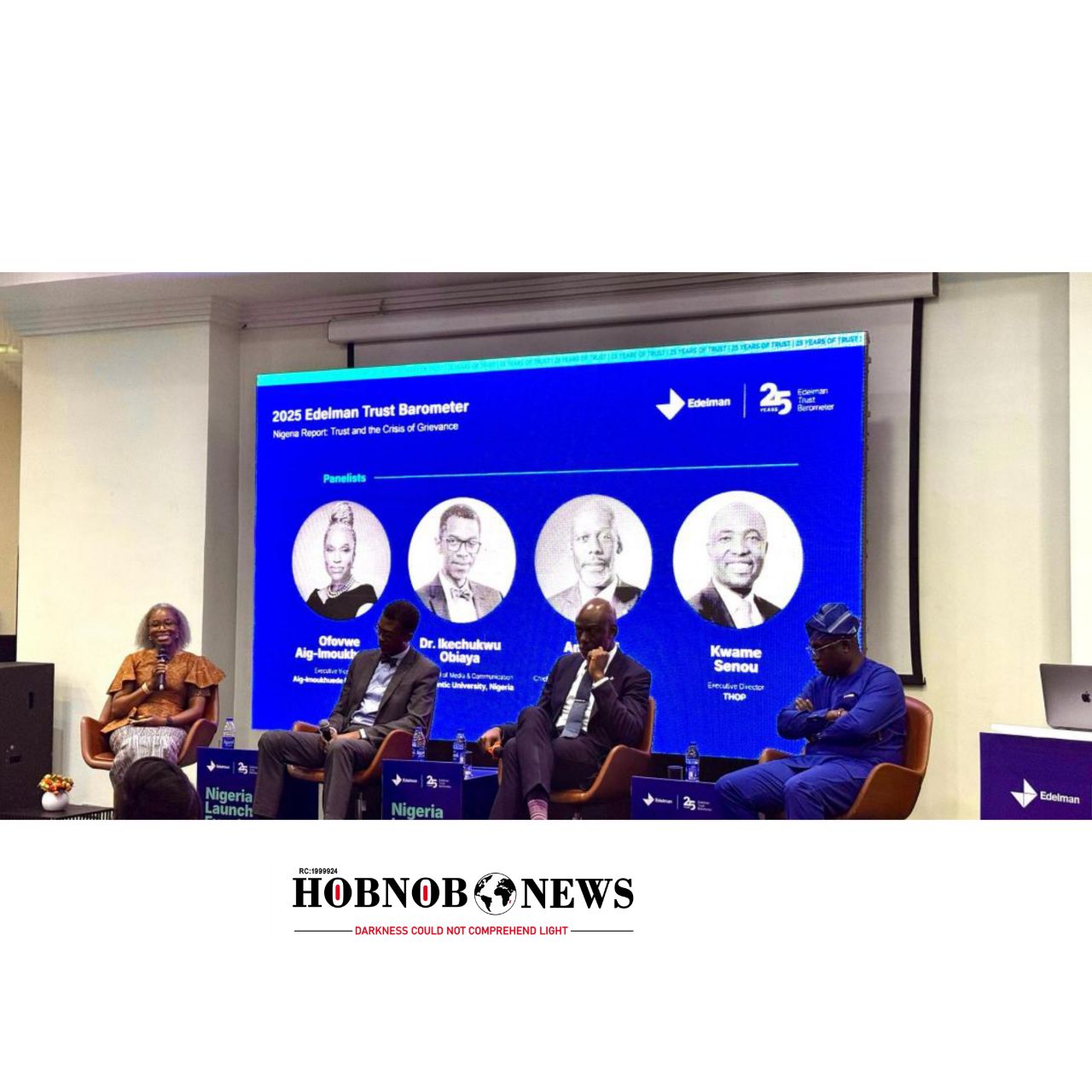
The launch event also featured a panel of experts from academia, the non-profit sector, and business, who examined the findings and suggested practical solutions for rebuilding trust in Nigeria. The session, moderated by media personality Olive Emodi, included contributions from Kwame Senou, Executive Director at The Holding Opinion (THOP); Ofovwe Aig-Imoukhuede, Executive Vice Chair at the Aig-Imoukhuede Foundation; Ikechukwu Obiaya, Dean at Pan-Atlantic University’s School of Media and Communication; and Amaechi Okobi, Chief Brand and Communications Officer at Access Holdings.
Mrs Aig-Imoukhuede began by urging Nigerians to move from blame to action. “We’re very good at complaining but not so good at providing solutions,” she said. “Collaboration is key. The problems we face as a country cannot be solved by one group alone.”
Mr Obiaya agreed and said Nigerians must begin reflecting on their individual roles in nation-building. “Grievance is real, but we must also ask ourselves: what part am I playing? We can’t leave it all to the government or NGOs. We’re all part of the solution.”
Mr Okobi stressed that trust must start at the interpersonal level. “If an employee feels their boss lacks empathy, how can trust be built?” he asked. He shared a personal experience to highlight this: “When I stopped just reporting problems and started suggesting solutions, my leaders listened. That spirit of collaboration and responsiveness is what we need in Nigeria.”
Mrs Aig-Imoukhuede also shared her foundation’s initiatives aimed at reforming the civil service. “We focus on the civil service. We try to make it better. One big project we’ve worked on since 2020 is digitalisation — helping the federal civil service move from manual to digital processes. That will remove many of Nigerians’ issues in accessing government services.”
She emphasised the interdependence of both public and private sectors. “The private sector will thrive when the public sector thrives. We’re calling on them to help build capacity in public institutions — many civil servants don’t even have the resources or workspaces they need. We must close that gap.”
On the issue of accountability, Aig-Imoukhuede stressed the importance of data. “Data is so important. When you have evidence, you have more than just opinion — you have facts,” she said. She cited Tracka by BudgIT, which enables Nigerians to monitor government projects in their communities. “Transformation has happened because people could ask: this classroom was supposed to be built — where is it?” she said.
Senou raised an important philosophical question during the discussion: “Are we truly a nation or just individuals living within borders?” Drawing from his experience as a foreigner raising Nigerian children, he observed a lack of collective responsibility among Nigerians. “When it’s personal, people act. But when it’s about the community, we point fingers,” he said.
The media also came under scrutiny, especially in light of the report’s finding that 70 per cent of Nigerians believe journalists knowingly mislead the public. Mr Obiaya said this perception is partly rooted in ownership and economic pressures. “Politicians own many media houses. During election cycles, journalists often can’t publish freely. Add to that poor salaries, and it’s hard to uphold ethics,” he noted.
The Global Context and Glimpse of Optimism
Globally, China, Indonesia, and the UAE were identified as the most trusted countries, while the UK, Germany, South Korea, and Japan ranked lowest in the trust index. In contrast, despite Nigeria’s ongoing economic, political, and social struggles, 50 per cent of Nigerians said they remain optimistic about the country’s future — a more hopeful outlook compared to many advanced economies.
A goodwill message delivered by Omoniyi Ibietan, Secretary-General of the African Public Relations Association (APRA), on behalf of its President Arik Karani, praised the Edelman Trust Barometer as an invaluable tool for understanding the evolution of trust in institutions and leadership. “It is an honour to be here for the launch of the 23rd edition of the Edelman Trust Barometer — a landmark achievement that not only celebrates a quarter-century of global research but reflects the growing importance of trust as a currency of modern leadership,” he said.
Mr Ibietan added that trust plays a central role in effective leadership and social progress. He urged leaders to recognise that building trust requires consistent communication, ethical conduct, and practical results that improve people’s lives.
The report ends with a sobering but hopeful message: while Nigeria remains deeply divided and distrustful of its government, other institutions have the opportunity — and responsibility — to lead the charge in restoring public confidence. As Cindi concluded, “Trust can be restored. But it takes action, integrity, and commitment from all sectors.”

