

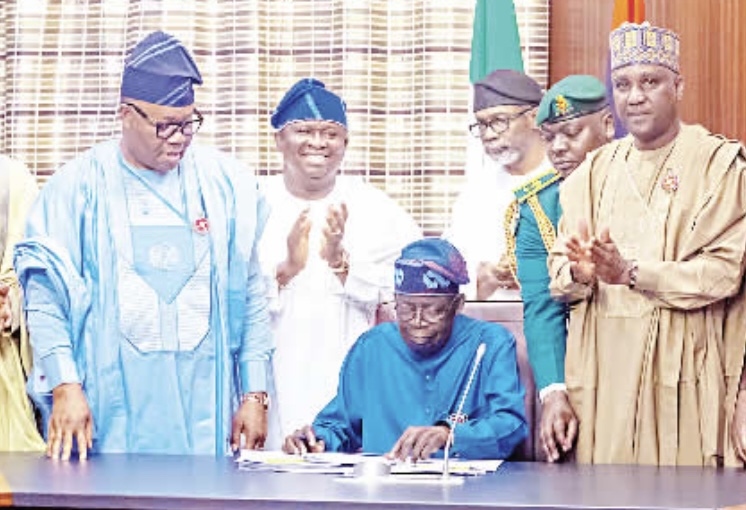
President Bola Tinubu has signed into law the N54.99 trillion ($36.6 billion) 2025 Appropriation Bill, marking a significant fiscal commitment towards economic stability and national development. The signing took place on Friday at a small ceremony in his office at the State House, Abuja, in the presence of principal officers of the National Assembly and other top government officials.
The budget, which was passed by both chambers of the National Assembly on Thursday, February 13, surpasses Tinubu’s initial proposal of N54.2 trillion. Lawmakers approved the increase following the president’s request to raise the initial N49.7 trillion proposal, citing additional anticipated revenues from agencies such as the Federal Inland Revenue Service and the Nigeria Customs Service.
Key Budget Priorities:
The 2025 budget focuses on critical sectors, including security, infrastructure, education, and healthcare. Notably, $200 million has been allocated to mitigate the impact of recent U.S. health aid reductions.
The budget is built on ambitious economic assumptions, with a crude oil production target of 2.06 million barrels per day at a benchmark price of $75 per barrel. Additionally, the Federal Government projects an exchange rate of N1,500 to the U.S. dollar and aims to lower inflation from 34.8% to 15% within the year.
Fiscal Strategy and Tax Reforms:
As part of efforts to boost revenue and economic stability, Tinubu’s administration has introduced tax reforms, including a proposed increase in the value-added tax (VAT) to 12.5% by 2026. However, essential goods such as food and medicine will be exempted to cushion the impact on households.
Another key reform involves reallocating VAT revenues to favor states generating higher revenue, a move that has sparked debate on regional economic disparities.
The 2025 Appropriation Act represents a 99.96% increase from the N27.5 trillion 2024 budget, reflecting the government’s aggressive fiscal expansion strategy. With this budget, the Tinubu administration aims to drive economic recovery, strengthen infrastructure, and improve citizens’ living standards in the face of ongoing economic challenges.

