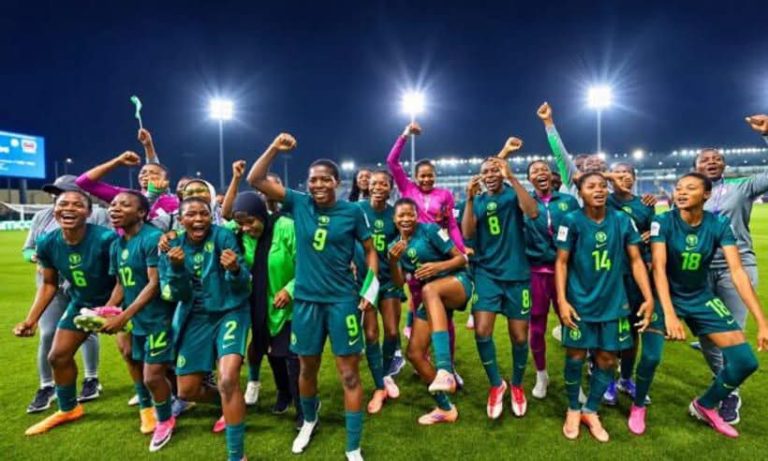
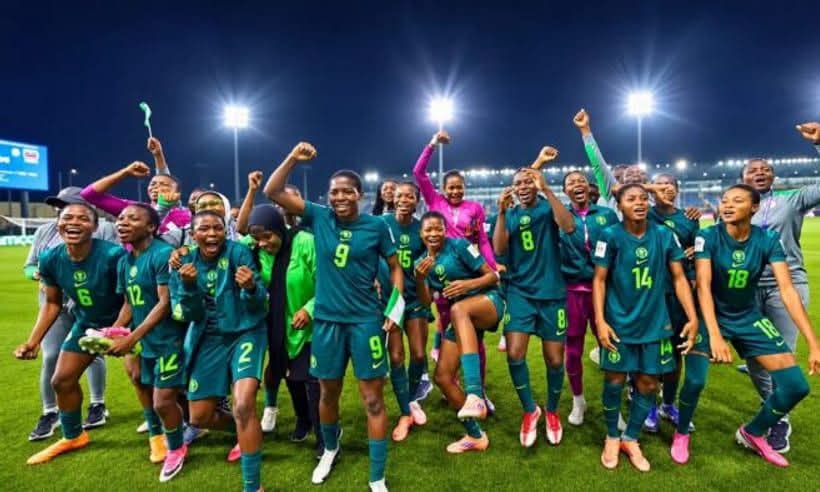
Nigeria’s U-17 women’s national team, the Flamingos, have made history by winning their first-ever FIFA U-17 Women’s World Cup title following a 2-1 victory over Japan in the final at the Mohammed VI Football Complex in Rabat, Morocco.
The historic triumph also makes Nigeria the first African country to win a FIFA world title at any level, male or female, marking a significant milestone for Nigerian and African football.
The Flamingos’ journey to the trophy was not without challenges, as they suffered a 2-1 defeat to Poland in their opening group-stage encounter, raising questions about their readiness for the competition.
However, the Nigerian girls responded impressively, recording six consecutive victories to demonstrate their resilience, tactical discipline and ability to improve under pressure.
They defeated Puerto Rico before securing a remarkable 3-1 victory over defending champions North Korea. Nigeria subsequently overcame Mexico 2-1 in the Round of 16 and edged Venezuela 1-0 in the quarter-finals.
Their semi-final encounter against Brazil produced another memorable performance, as the Flamingos defeated the South Americans 3-1, handing them their first defeat of the tournament and making Nigeria the first African team to reach the final of the FIFA U-17 Women’s World Cup.
In the final against Japan, Nigeria took control of proceedings, with Awawu Bashiru opening the scoring in the first half through a long-range effort that slipped through the Japanese goalkeeper’s hands.
Just two minutes into the second half, Oluebube Umejiaku doubled Nigeria’s advantage with a composed chip over the goalkeeper. Umejiaku, who was subsequently named the tournament’s best player, received the Golden Ball award.
Japan reduced the deficit through Fuki Ito in the 80th minute, but the Flamingos maintained their defensive discipline to secure the historic 2-1 victory and lift the trophy.
Beyond the Trophy: The Challenge of Building a Lasting Legacy
Despite the historic achievement, questions have emerged about the future of the young players and whether Nigeria can provide the necessary structures to sustain their development.
The triumph comes at a time when Nigerian football has experienced disappointments at senior international level, with the Super Eagles failing to qualify for the 2026 FIFA World Cup and the Super Falcons missing out on the 2027 FIFA Women’s World Cup after losing to South Africa in a play-off.
The Flamingos’ achievement has therefore renewed optimism about the country’s footballing potential, while highlighting the importance of investing in young talents.
Speaking to DAILY POST, Lagos-based journalist Femi Fabunmi said the team’s success was built on strong understanding, individual brilliance and collective cohesion.
“The Flamingos did fantastically well with team cohesion and all-round play. The team is full of individually brilliant players, and they play with perfect understanding,” Fabunmi said.
He stressed that the future of the players would largely depend on how the Nigeria Football Federation (NFF) manages and develops their potential.
“Their progress is dependent on how they [NFF] can harness the ladies. But with proper harnessing, they could grow as far as the Super Falcons because they have the materials,” he added.
Similarly, Eagle Stars FC coach Isma’il Musa attributed Nigeria’s historic achievement to the players’ talent, discipline and quality coaching.
According to Musa, the team’s ability to recover from their opening defeat and maintain an impressive winning run demonstrated their strong mentality and determination.
“The Flamingos conquered the world through talent, discipline and good coaching,” Musa told DAILY POST.
“Their ability to bounce back from an early defeat and keep improving throughout the tournament showed their strong mentality.
“What comes next is even more important. Nigeria must ensure these players continue to develop through quality coaching, competitive football and a clear pathway to the Falconets and Super Falcons.
“If we invest in them and strengthen girls’ football at the grassroots, this victory can become the beginning of a lasting legacy rather than just a beautiful moment,” he said.
Nigeria’s historic victory in Morocco has established the Flamingos as pioneers in African football. However, sustaining their success will require deliberate investment in grassroots football, improved development programmes, competitive opportunities and a structured transition into the country’s senior women’s national team.
For the Flamingos, winning the world title is a remarkable achievement. For Nigerian football authorities, the bigger responsibility is ensuring that the young champions receive the support and opportunities needed to become the future of the Super Falcons.
About The Author