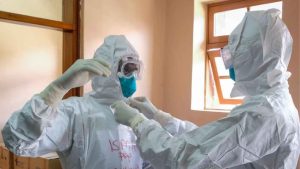
The Nigeria Centre for Disease Control and Prevention (NCDC) has placed Kano, the Federal Capital Territory (FCT), Lagos and seven other states on high alert following the rising outbreak of Bundibugyo Ebola Virus Disease in Uganda and the Democratic Republic of Congo (DRC).
In a nationwide advisory issued on Thursday, the agency warned that Nigeria remains vulnerable to a possible importation of the virus due to increased international travel, cross-border movement and porous borders.
Other states listed as high risk include Rivers, Enugu, Borno, Akwa Ibom, Cross River, Taraba and Adamawa, while Kaduna, Katsina, Bauchi and Plateau were classified as moderate-risk states.
The alert followed the World Health Organisation’s declaration of the outbreak as a Public Health Emergency of International Concern.
Although no Ebola case has been confirmed in Nigeria, the NCDC directed all states to immediately strengthen surveillance systems and emergency preparedness measures to prevent any possible spread.
According to the agency, the outbreak in Uganda and the DRC has resulted in more than 1,000 suspected infections and 247 deaths, with young and middle-aged persons accounting for most of the cases.
The NCDC explained that unlike some other Ebola strains, there is currently no approved vaccine or specific treatment for the Bundibugyo strain, making early detection, rapid isolation and containment measures critical.
The agency further stated that the disease spreads through direct contact with infected body fluids, contaminated materials or infected animals, stressing that it is not airborne.
Common symptoms include fever, weakness, headache, vomiting, diarrhoea, skin rash and unexplained bleeding.
As part of precautionary measures, the NCDC said its Emergency Operations Centre had been placed on alert mode, while all states were instructed to submit readiness reports within 72 hours and immediately report any suspected case.
Director-General of the NCDC, Dr. Jide Idris, urged health authorities and stakeholders across the country to take proactive measures before any case is detected in Nigeria.
He noted that Nigeria’s previous success in containing Ebola outbreaks was achieved through swift response mechanisms, strict infection prevention measures and strong public cooperation.