Months after coordinated attacks claimed dozens of lives in Odeni Gida Ward of Udege Development Area, Nasarawa Local Government Area of Nasarawa State, survivors are raising fresh concerns that the tragedy has entered a troubling new phase, with alleged attackers now occupying communities they forced residents to abandon.
The attacks, which left more than 80 people dead across several settlements, resulted in widespread destruction of homes, farmlands, food stores and other property worth hundreds of millions of naira. While the violence itself shocked residents, many say the aftermath has become equally disturbing.
Displaced villagers accuse authorities of downplaying the scale and nature of the attacks by repeatedly describing them as “communal clashes,” a characterization they insist fails to reflect what they experienced.
According to residents, the violence involved coordinated assaults by heavily armed attackers who simultaneously invaded multiple communities, killing residents, burning homes and forcing entire populations to flee.
For survivors, the dispute over terminology goes beyond semantics. They argue that how the attacks are classified could have far-reaching implications for justice, accountability, compensation and the future ownership of ancestral lands.
The concerns have intensified following reports that some of the individuals identified by residents as participants in the attacks are now openly grazing cattle in deserted communities whose original inhabitants remain displaced.
During a recent visit to affected areas by President Bola Tinubu’s Special Assistant on Community Engagement, Dr. Abiodun Essiet, residents reportedly highlighted the continued occupation of abandoned settlements and the lingering fear preventing many families from returning home.
“The attackers have now taken over the very communities they displaced. That tells you this was never just a clash. It was a conquest,” one resident said.
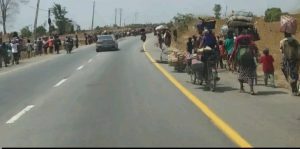
Images and videos circulating online appear to illustrate the scale of the displacement, showing women, children and elderly residents carrying belongings as they fled to neighboring communities in search of safety.
Many victims also express frustration that public attention has gradually shifted away from the crisis despite reports of continued insecurity, intimidation and attacks on farmers in surrounding areas.
Some community members have accused local leaders of weakening efforts to secure justice by participating in reconciliation meetings that allegedly portrayed the crisis as resolved while many victims remained displaced.
Others criticized the distribution of relief materials, claiming that aid was shared in a manner that appeared to place victims and alleged perpetrators on equal footing, reinforcing the narrative that the violence was merely a communal dispute.
Although meetings were reportedly held between affected communities and Fulani leaders, residents say little information has emerged regarding the implementation of agreements reached during those engagements.
One of the strongest critics of the official narrative, public affairs commentator Yahaya Kana Ismaila, insists the attacks bear the hallmarks of organized armed violence rather than communal conflict.
According to him, the affected Eloyi communities share neither ethnic affiliation nor territorial identity with the armed men accused of carrying out the attacks, undermining claims that the violence stemmed from a communal dispute.
Kana argued that the attackers arrived in large numbers with sophisticated weapons, launched simultaneous attacks on multiple settlements, and systematically destroyed homes and livelihoods before forcing residents to flee.
“The painful reality is that many innocent people have been left traumatised, displaced, and uncertain about their future. Entire communities have been shattered, while survivors are expected to simply return and rebuild their lives amid fear and insecurity,” he stated.
He warned that the absence of arrests and accountability months after the attacks could embolden criminal groups and deepen insecurity across the state.
According to him, despite reports that more than 70 people were killed, no suspects had been arrested at the time of his reaction, raising serious concerns about justice and protection for vulnerable communities.
Residents say the attacks destroyed homes, farm produce, motorcycles and livelihoods built over many years, leaving many families struggling to recover.
The situation has also fueled growing distrust in local authorities, with victims questioning the response of the Nasarawa State Government, security agencies and emergency management institutions.
Abdulwahid Angala Odeni, reacting to renewed tension in parts of Odeni Gida Ward, described the situation as devastating.
“My people are shattered and homeless. My heritage is under invasion by radical hoodlums Fulani herdsmen. Odeni Gida Ward, Udege Development Area, Nasarawa Local Government Area, Nasarawa State. The Government of Nasarawa State should come to our aid,” he appealed.
Another resident, Suleiman Otto Wakili, called on the Federal Government to intervene.
“Fulani herdsmen attacked Sabon Gida Angwa Ogiri in Odeni Gida Ward, Nasarawa State. The Federal Government should take action concerning our situation please,” he said.
Residents also expressed concern over what they describe as inadequate humanitarian assistance despite earlier assurances that support would be provided to displaced persons and facilitate their safe return home.
As displaced families continue to struggle between uncertainty and survival, many are now directing their appeals to the Presidency, urging federal authorities to intervene before more communities are permanently lost to displacement and insecurity.
For many survivors, one question remains unanswered: if residents cannot safely return to their ancestral homes, who now controls the land they were forced to leave behind?